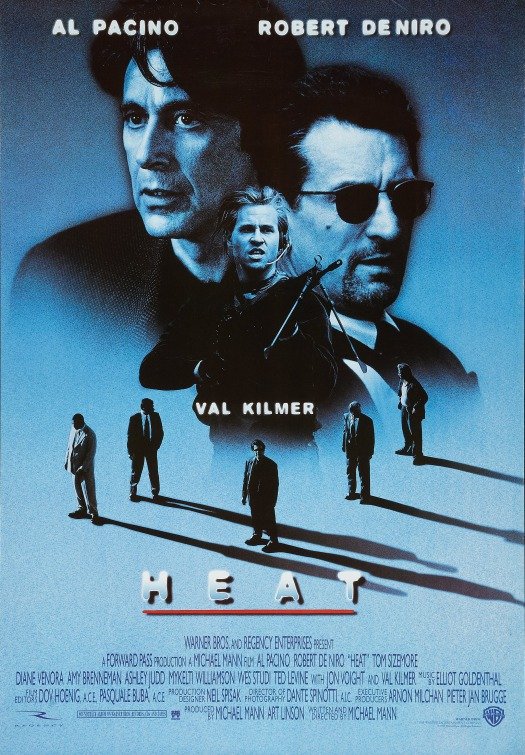
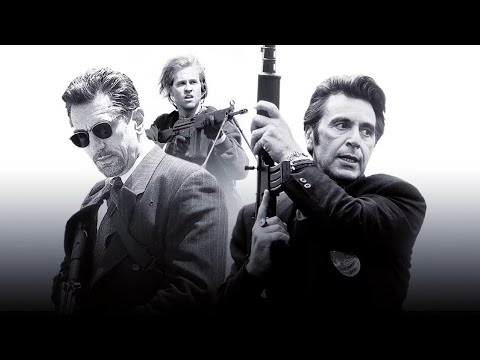
Heat is the rare crime epic that earns every minute of its nearly three-hour runtime, because Michael Mann treats both sides of the law with the same seriousness and craft. Al Pacino and Robert De Niro anchor it, but the film is just as interested in Val Kilmer's crumbling marriage or Jon Voight's grizzled fence as it is in its two icons, building out a whole ecosystem of professionals on both sides of the badge. The much-discussed diner scene between Pacino and De Niro is a masterclass in restraint, two legends underplaying a conversation that the whole movie has been building toward, and it earns every ounce of its reputation.
The heist sequences are shot with a clarity and physical weight that most modern action films still can't match — Mann trained his cast for months, and it shows in how the guns are handled and how the downtown shootout unfolds with real spatial logic instead of chaotic cutting. But what elevates Heat above a well-made genre exercise is its patience with character: everyone here, cop and criminal alike, is defined by the personal cost of a life built around the job. It's a film for anyone who wants their crime thriller to also function as a genuine character study, and it rewards rewatching more than almost any studio film of its decade.
Two legends, one diner scene, and a crime epic that never wastes a minute of three hours.
If you've somehow missed it, Heat is essential viewing — not just for crime fans but for anyone who wants to see two of the greatest actors of their generation finally share a scene, then watch a director build an entire, sprawling city of a movie around them. It earned strong reviews on release and its reputation has only grown since, visibly shaping later filmmakers from Christopher Nolan onward. Set aside an evening for it, because it's not built for background viewing — every scene is doing quiet work toward the whole, and the payoff is one of the most satisfying endings the genre has ever produced.
Heat began as Michael Mann's own 1989 script, which the network initially turned into the television film L.A. Takedown when a full theatrical production didn't materialize; Mann returned to the story years later with a much larger budget and cast. The plot is loosely inspired by a real Chicago robbery pursuit between detective Chuck Adamson and a career criminal also named Neil McCauley, details Mann drew on from his own earlier friendship with Adamson. Al Pacino and Robert De Niro had both appeared in The Godfather Part II, but never shared a scene together on screen; Heat marked their first true face-to-face pairing, a fact that fueled much of the film's pre-release anticipation.
Critics responded warmly at the time, and Heat holds an 84 percent approval rating among reviewers on Rotten Tomatoes, with particular praise for Mann's direction and the two central performances. It grossed roughly $187 million worldwide against a reported $60 million budget, a solid though not spectacular commercial result for its scale. Its influence has proven larger than its initial box office suggests: the U.S. Army has reportedly used footage from the film's tactical shootout sequence in training materials, and the film is widely cited as an influence on later works including Christopher Nolan's The Dark Knight and the Grand Theft Auto video game series.