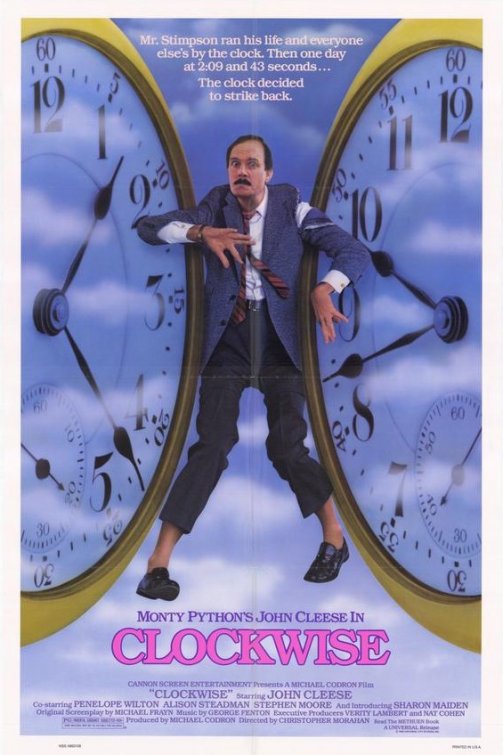
John Cleese plays Brian Stimpson, a comprehensive school headmaster so devoted to punctuality that he's about to become the first non-public-school head to address the Headmasters' Conference, a moment he's clearly been rehearsing his whole career for. Then he misses his train by seconds, and Michael Frayn's script spends the rest of the film watching one small delay metastasize into an entire day of increasingly disastrous improvisation.
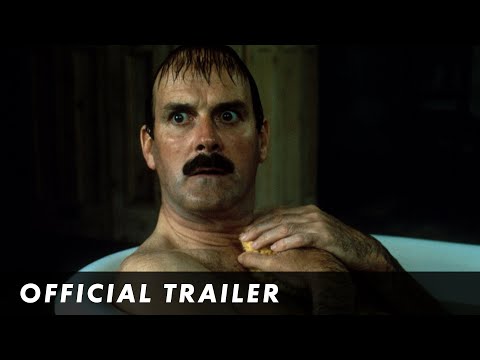
Christopher Morahan directs it as pure farce mechanics, each new decision Stimpson makes to save time costing him more of it, dragging in a hijacked schoolgirl, a stolen car, and an ex-girlfriend he hasn't spoken to in years. Cleese is playing a variation on the barely-contained fury he perfected as Basil Fawlty, but Stimpson's control-freak precision curdling into chaos gives the performance its own shape, funnier for how logically each disaster follows the last.
Watching one man's need for control demolish his entire day is very, very funny
It's a tightly built machine of a comedy, escalating with real precision instead of just piling on random mishaps, and it earns every laugh along the way to Stimpson's total unraveling. 4.0 ears and 70% worth your time is a fair mark for a smart, well-constructed farce that doesn't waste a single scene getting Stimpson from bad to catastrophically worse.
Clockwise starred John Cleese as an obsessively punctual headmaster whose day unravels after he boards the wrong train, in a script playwright Michael Frayn wrote on spec, reportedly inspired by his own repeated struggles catching trains on time. Christopher Morahan was brought on to direct partly because Cleese had enjoyed his staging of Frayn's adaptation of Chekhov's Wild Honey in the theater. Cleese later called it the only truly excellent script he was ever offered for a lead role, though he has said he disagreed with Frayn over how the story's ending should land, wanting a more upbeat resolution for his character.
Clockwise underperformed badly in the United States, where it received only a limited arthouse release and grossed well below its budget, but it has remained more fondly remembered in Britain over the years. Its humor comes almost entirely from mounting, believable inconveniences rather than absurdist plotting, giving Cleese a chance to play barely contained panic rather than his more anarchic Monty Python or Fawlty Towers register. It's a good match for viewers who enjoy quieter, more restrained British comedies built on escalating bad luck, or anyone curious about a lower-key side of Cleese's comic persona.
Clockwise was shot almost entirely on location around the English Midlands and Yorkshire, using real institutions to sell its everyday chaos — Menzies High School in West Bromwich stood in for Stimpson's school, King Edward's School and the University of Birmingham supplied academic gravitas, and Hull's Paragon Station and Shrewsbury Abbey turn up along his cross-country odyssey. The production's escalating set pieces took real time to engineer: one stretch reportedly needed four days of shooting to produce roughly ten minutes of finished film, which says a lot about how much choreography farce like this actually demands. The work paid off for Cleese personally, too — his performance won the 1987 Peter Sellers Award for Comedy at the Evening Standard British Film Awards, an early sign that critics saw more than a Fawlty Towers retread in Stimpson's meltdown.