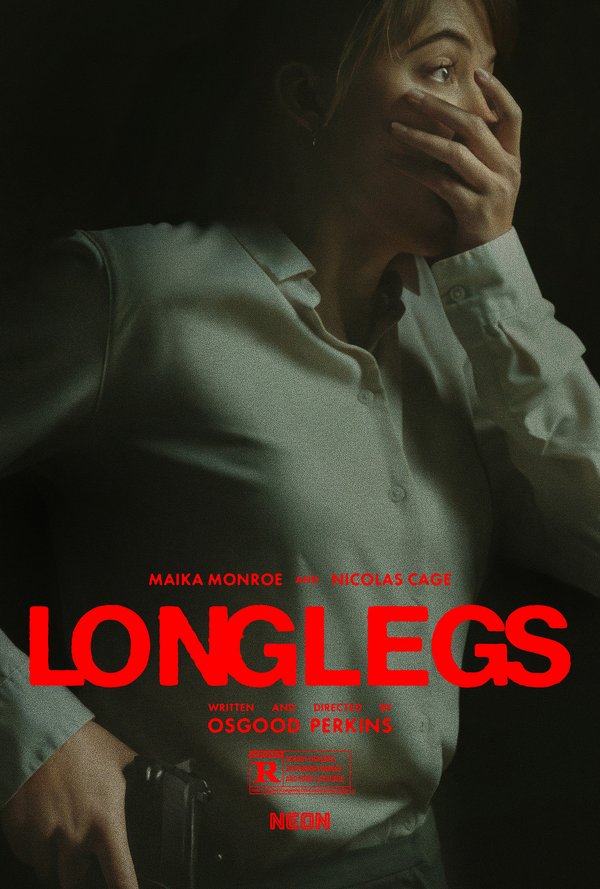
Osgood Perkins builds this less like a serial-killer procedural and more like a slow poison: long static shots of empty hallways, muted 1990s production design, a color palette drained almost to gray. Maika Monroe plays FBI agent Lee Harker with a stillness bordering on shutdown, a performance that makes her occasional flickers of fear register as genuinely alarming rather than routine scream-queen reaction shots. The case itself, tied to satanic-panic iconography and a killer who may never physically enter the houses where people die, unfolds through cryptic ciphers and half-explained rules the film refuses to fully rationalize, trusting atmosphere over exposition to keep you unsettled.
Cage's performance, held back until well into the runtime, is the film's most divisive element, a warbling, prosthetic-heavy, almost operatic turn that some will call a masterstroke of dread and others will find too theatrical for the clinical world around it. Whichever side you land on, isolating him in a handful of scenes, mostly shot in extreme close-up or from odd angles, keeps him from ever becoming familiar enough to stop being frightening. The sound design does a lot of quiet, ugly work too: hums, static, distorted phone calls, building a sense that something is wrong with the recording itself, not just the story.
A serial-killer movie that treats the killer as a rumor and lets that rumor do the damage.
This rewards people who like their horror puzzle-boxed and a little cryptic, closer to Zodiac's obsessive unsolvability than a conventional killer-catching thriller. It's also a good pick for anyone burned out on found-footage or torture-adjacent horror who wants something that scares through mood and suggestion instead; a lot of the nastiest ideas here are implied rather than shown. The marketing oversold it as an all-time scariest-movie-ever event, which set expectations the slow-burn structure doesn't quite match, but on its own patient terms, it's an effective, off-kilter piece of dread.
Longlegs was written and directed by Osgood Perkins, son of Psycho star Anthony Perkins, and produced in part through Nicolas Cage's own Saturn Films banner alongside Range and Traffic. Shot largely in Vancouver on a budget of roughly $10 million, the production leaned into a deliberately muted, desaturated look inspired by 1990s crime thrillers. Distributor Neon ran an unusually secretive marketing campaign built around cryptic ciphers, unmarked crime-scene-style posters, and a working phone hotline where callers could hear Cage's character deliver in-character dialogue, generating significant online speculation before anyone outside the production had seen his full look in the role.
The strategy paid off commercially: Longlegs opened to the biggest debut ever for an independently distributed original horror film, and went on to gross more than $126 million worldwide against its modest budget, making it one of Neon's most profitable releases. Critical response was largely positive, with particular praise for Monroe's performance and the film's oppressive atmosphere, though some reviewers felt the back half's explanations undercut the mystery built in its first hour. It cemented Perkins, previously known for smaller works like The Blackcoat's Daughter, as a horror director capable of a mainstream hit without softening his slower, art-house instincts.