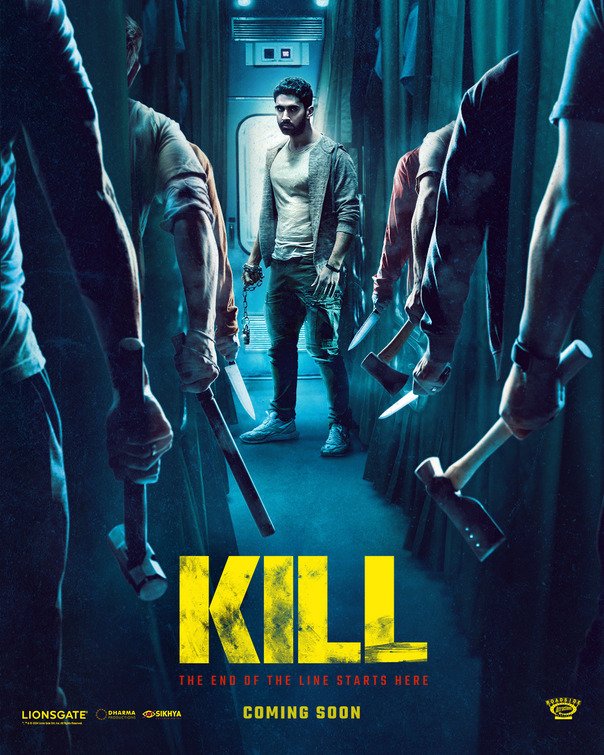
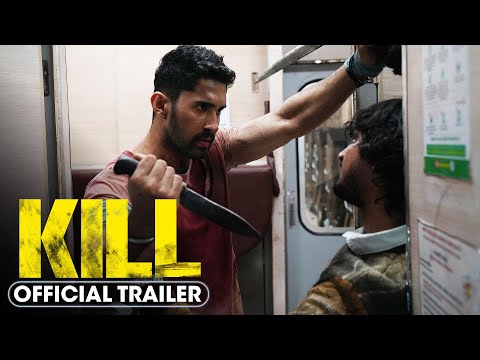
Kill announces its intentions early and then keeps raising the stakes past the point most action movies would stop. Lakshya plays Amrit, a National Security Guard commando who boards a train home only to find it overrun by roughly forty armed robbers led by a sociopathic gang leader played by Raghav Juyal. What starts as a rescue mission for his girlfriend turns into an hour-plus of hand-to-hand combat confined almost entirely to corridors, sleeper compartments, and connecting vestibules, and director Nikhil Nagesh Bhat treats that confinement as the whole design brief rather than a limitation to work around.
The fight choreography leans on fire extinguishers, luggage racks, box cutters, and whatever else happens to be bolted to a train car, and the close-quarters camera work makes every hit feel like it costs both fighters something. Juyal, mostly known for comedy and dance on Indian television, turns in a performance so unhinged it reframes the whole movie — his character isn't a stock villain so much as a specific kind of cruelty that escalates the film's brutality scene by scene. By the midpoint, Kill has abandoned any pretense of restraint, and its willingness to keep going past where most films would cut to black is exactly what makes it memorable.
A single train car, forty bandits, and no interest in slowing down.
Watch this one on the strength of its choreography alone if the premise doesn't already sell you — few recent action films use a single, unchanging location this well, turning a train's narrow geography into an asset rather than an obstacle. It's brutal enough that some viewers will find the back half exhausting rather than thrilling, but that exhaustion is the point: this is a film built to leave you as wrung out as its characters.
Kill was produced by Dharma Productions and Sikhya Entertainment, with Karan Johar among its producers — a notable pairing, since Dharma is better known for glossy Bollywood romances than R-rated action. The cast trained for months in close-quarters combat choreography developed by South Korean action director Se-yeong Oh alongside Indian choreographer Parvez Shaikh, building fight sequences around found weapons rather than firearms or formal martial-arts forms. The film was shot largely aboard a real, specially outfitted train set to preserve the geography of connected compartments the story depends on.
Kill opened in India in July 2024 to strong reviews praising its sustained intensity, and it later reached a wider audience via international streaming and festival play, including a US theatrical release. Its reputation grew enough that John Wick director Chad Stahelski's 87Eleven Entertainment optioned an English-language remake for Lionsgate within months of release. It's now frequently discussed alongside The Raid as one of the more effective confined-space action films of the 2020s.
Kill's reputation only grew once American critics got a proper look at it: the film holds a 90% score on Rotten Tomatoes across more than 100 reviews, with reviewers repeatedly calling it one of the most purely brutal action films in years. Filmmaker Anurag Kashyap, never shy with a strong opinion, called it the 'Train to Busan of Indian cinema' and praised it as the best action film India had produced to date — a comparison that stuck and followed the film through its festival and streaming rollout. Commercially it was a slow burn rather than a hit out of the gate, opening on a modest ₹20 crore budget and building to roughly ₹47 crore worldwide mostly through word of mouth, the kind of trajectory a genuinely exceptional recommendation-driven film tends to have.