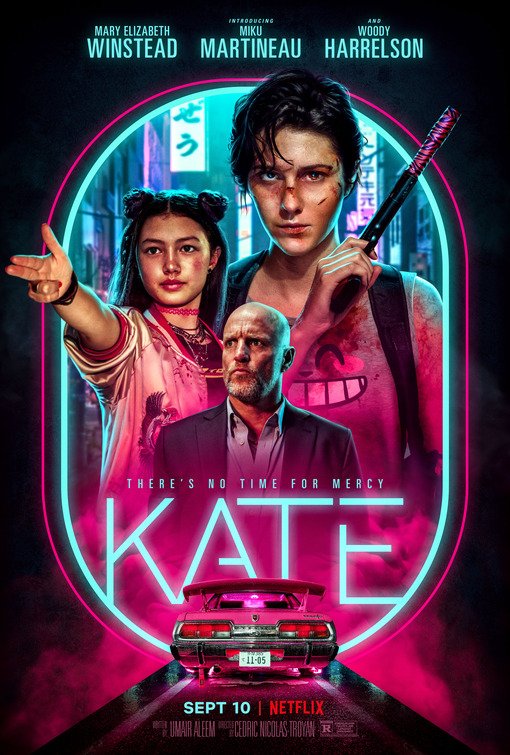
Kate is a professional killer who gets poisoned mid-job, and instead of spending her final hours in a hospital bed she spends them working through the people who did it to her. Mary Elizabeth Winstead plays her as furious and increasingly wrecked in equal measure, which gives the movie's ticking-clock gimmick real weight instead of just an excuse for a countdown graphic.
Tokyo becomes one long, mean chase, and the film is smart enough not to pad it with backstory it doesn't need. Woody Harrelson shows up as her handler with just enough conflicted loyalty to keep things interesting, and the fight choreography goes for brutal and practical over slick. There's a teenage girl dragged along for the ride who could have been dead weight but mostly earns her place.
Kate doesn't waste time being subtle about how little time it has.
It's not reinventing the poisoned-assassin formula, and it doesn't try to. What it does is commit fully to being mean, fast, and efficient, trusting Winstead to sell the physical toll without turning it into misery-porn. There isn't a wasted scene in the whole runtime. If you want a genre exercise done with real conviction instead of irony, Kate delivers exactly what it promises and gets out.
Kate arrived on Netflix in 2021, directed by Cedric Nicolas-Troyan and shot on location across Thailand and Tokyo before wrapping in Los Angeles. Mary Elizabeth Winstead, already known for genre work in 10 Cloverfield Lane and Scott Pilgrim vs. the World, trained intensively for the physically demanding role, working closely with a stunt double who was injured on the first day of the shoot, a setback that reshaped how the production approached its fight choreography. Critics were divided on the finished film, generally praising Winstead's committed, physical performance while noting that the story leaned heavily on conventions already familiar from other assassin thrillers of the period.
The film belongs to a wave of female-led assassin movies that followed in the wake of John Wick's success, sitting alongside titles like Gunpowder Milkshake, The Protégé, and Jolt in reworking that template around a woman racing against a countdown. Its neon-drenched Tokyo setting and club sequences, including a cameo performance from Japanese rock band Band-Maid, give it a distinct visual identity even where the plot mechanics feel borrowed. For viewers who enjoy stunt-driven, propulsive action built around a ticking clock, Kate offers a lean, R-rated genre exercise anchored by a physically committed lead performance.
Kate was actually the second directing credit for Cedric Nicolas-Troyan, a French-born visual effects artist who earned an Oscar nomination for his effects work on Snow White and the Huntsman before making his directorial debut on its sequel, The Huntsman: Winter's War — a background that shows in how deliberately the film's Tokyo set pieces are staged and lit. Made on a reported $25 million budget, Kate found a real audience once it landed on Netflix, cracking the platform's global Top 10 and reaching more than 56 million subscriber households within its first month, numbers that comfortably outpaced its muted critical reception.