
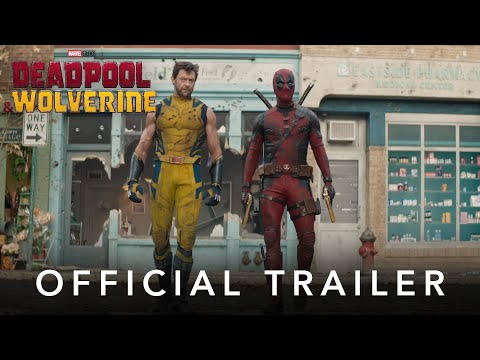
Deadpool & Wolverine is at its best when it stops pretending to have a plot and just lets two exhausted, bickering icons share a screen. Shawn Levy structures the film as a victory lap disguised as a rescue mission, and the connective tissue — TVA bureaucracy, a vaguely defined apocalypse — matters far less than the friction between Wade's motormouth self-awareness and Logan's weary refusal to play along. The film is loudest and funniest exactly when it stops trying to justify its own existence and just admits it's a two-hour reunion tour, which is a legitimately clever way to close out Fox's messy X-Men era on its own terms rather than pretending it never happened.
Ryan Reynolds has always been the engine of this franchise, but the film's better trick is finally giving Hugh Jackman a version of Wolverine who gets to be funny without losing the character's underlying bitterness — this Logan carries a specific, unresolved failure from his own timeline that gives their sparring actual stakes underneath the jokes. Emma Corrin's Cassandra Nova is a rare recent MCU villain with a clear, personal grudge instead of a vague cosmic threat, and the decision to stage her powers as psychological invasion rather than just physical combat gives the third act a nastier edge than the marketing suggested.
Marvel's biggest self-own of a party ever thrown, and everyone's invited to laugh at it.
The film leans hard into stunt-casting variant Wolverines and resurrecting characters from abandoned Fox projects, most memorably Chris Evans returning not as Captain America but as the Human Torch, a bait-and-switch built specifically around audience assumptions from his Marvel history. The climactic tribute reel of behind-the-scenes footage from the studio's earlier X-Men and Fantastic Four movies, set to Green Day's 'Good Riddance,' was reportedly a late addition meant to give closure to actors and characters whose franchises Disney's Fox acquisition had left in limbo — an unexpectedly sincere beat inside a film otherwise built on irreverence.
Critics were split in a way that box office receipts never reflected: Rotten Tomatoes settled in the high 70s while Metacritic's score sat notably lower, with reviewers praising the Reynolds-Jackman chemistry while questioning whether the film had anything to say beyond nostalgia and fan service. None of that mattered commercially — it became the highest-grossing R-rated film ever released, crossing $1.3 billion worldwide against a $200 million budget, comfortably outpacing every prior Deadpool entry. It functioned simultaneously as a victory lap for Fox's messy X-Men era, a eulogy for the characters left behind by the Disney acquisition, and proof that Marvel Studios could still turn out a genuine box-office event after a rockier stretch of Phase Five.
Opening weekend numbers underline just how much appetite there was for this reunion: Deadpool & Wolverine debuted to $211 million domestically and $444.1 million worldwide, the biggest global opening ever for an R-rated release, easily surpassing the original Deadpool's 2016 debut. It was also the largest July opening weekend of all time, edging out The Lion King's 2019 debut, and the sixth-biggest domestic opening in box office history outright — numbers usually reserved for a new Avengers entry, not a spinoff built on gallows humor and gore. That kind of debut doesn't happen on marketing alone; it's a sign of just how much goodwill Reynolds and Jackman had built up simply by teasing this pairing for years before a frame of it existed.