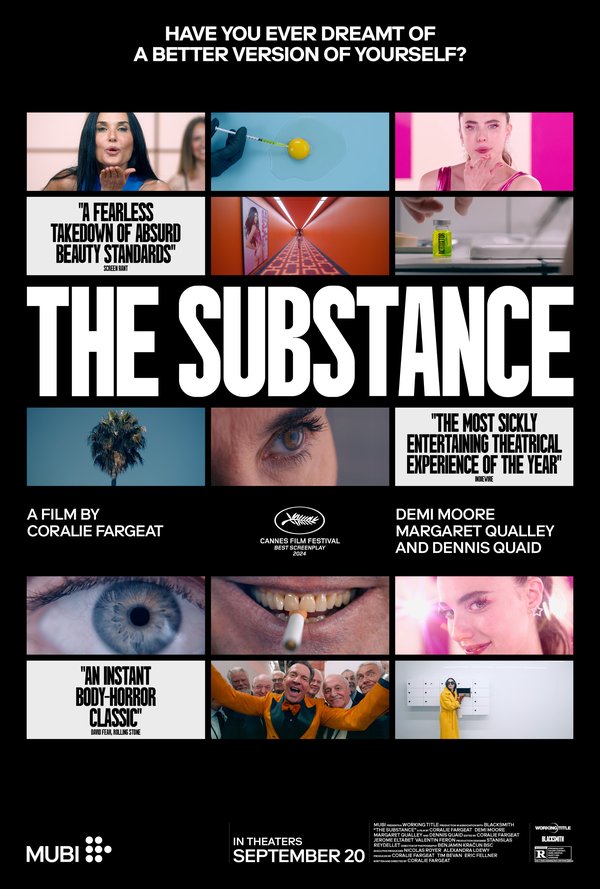

Coralie Fargeat isn't subtle about her target; the opening scenes of Elisabeth Sparkle's Hollywood Walk of Fame star getting installed, admired, then slowly cracked and trodden on practically narrate the film's thesis before a single line of dialogue lands. What keeps that heavy-handedness from sinking the movie is the sheer escalation: every rule the drug imposes gets broken a little further, every act of vanity gets punished a little more grotesquely, until the back third turns into a full-bore splatter climax that plays like a fashion-industry nightmare crossed with The Fly. Demi Moore, cast with clear-eyed awareness of her own industry history, gives a performance that's often physically humiliating by design and never lets that humiliation curdle into camp.
Margaret Qualley's half of the role is all glossy, hollow confidence, and the film's smartest trick is making her "improved" version just as trapped and miserable as the one she's replacing, just prettier about it. Fargeat shoots everything in extreme, almost fetishistic close-up, mirrors, syringes, skin, turning the female body into a battlefield of lighting and lens choices that recall Kubrick and Cronenberg in roughly equal measure. It's an aggressively maximalist film, loud in its music cues and its gore alike, and by the finale it has abandoned restraint entirely in favor of a berserk, practical-effects set piece that either lands as cathartic or simply exhausting depending on your tolerance for excess.
A beauty-industry satire that gets louder and bloodier instead of subtler, and dares you to keep watching anyway.
This suits horror fans who like their satire delivered with a sledgehammer rather than a scalpel; nothing here is coy about what it's saying about beauty standards and the entertainment industry's disposal of aging women. It's also a strong choice for anyone who enjoys practical body-horror effects done at a scale rarely funded anymore, since the final stretch is one of the more ambitious gore set pieces of the decade. Less patient viewers should know going in that the metaphor repeats itself loudly across two and a half hours rather than sharpening as it goes.
The Substance was written and directed by French filmmaker Coralie Fargeat, her second feature after 2017's Revenge, and produced by Working Title Films alongside Fargeat's own Blacksmith banner. It was shot largely in France with an international cast and financed as a UK-France-US co-production. Practical prosthetic effects were overseen by prosthetics designer Pierre-Olivier Persin, whose team built increasingly extreme creature and body-horror pieces for the film's final act, reportedly using large volumes of fake blood on set. The film premiered in competition at the 2024 Cannes Film Festival, where Fargeat won the Best Screenplay prize.
Demi Moore's performance became the centerpiece of the film's awards run, earning her a Golden Globe win for Best Actress in a Musical or Comedy and her first career Academy Award nomination for Best Actress, alongside nominations for Best Picture, Best Director, and Best Makeup and Hairstyling. Critics widely praised the film's audacity and Moore's willingness to be physically unflattering on screen, while some found the messaging repetitive over a lengthy runtime. Its awards success was frequently cited as a turning point for horror's standing at the Oscars, following other recent breakthroughs for genre films built around awards-caliber central performances.