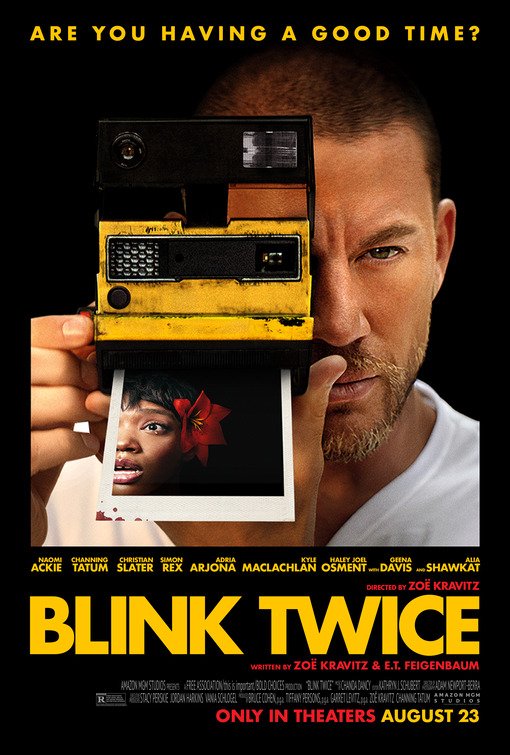

Zoë Kravitz's directorial debut arrives with a clear point of view: Blink Twice is less interested in the mechanics of its central mystery than in the slow, disorienting experience of not trusting your own memory. Naomi Ackie plays Frida, a cocktail waitress swept off to a tech billionaire's private island after a chance meeting at his fundraiser, and Kravitz builds the film's dread out of small continuity glitches — a missing day, a bruise no one remembers causing, a dress that's suddenly clean. The island itself, all warm light and top-shelf tequila, is staged like a luxury-resort commercial curdling in real time.
Channing Tatum, cast against his usual affable-leading-man type, plays the billionaire host as someone whose charm is the whole threat — soft-spoken, endlessly accommodating, and unmistakably in control of everyone around him. Kravitz surrounds him with a supporting cast, including Christian Slater, Simon Rex and Haley Joel Osment, who read as a pack rather than individuals, laughing a beat too long at each other's jokes. Alia Shawkat, as Frida's more skeptical friend, gives the film its clearest audience surrogate, someone whose suspicion the plot rewards rather than punishes.
A luxury vacation that curdles into a nightmare one missing memory at a time.
Kravitz wrote the script with E.T. Feigenbaum under the working title Pussy Island, a name she'd used since starting the project in 2017, before changing it ahead of release amid pushback over how provocative it read on a marquee. Production shot largely in Yucatán, Mexico, transforming a converted 17th-century hacienda near Mérida into the fictional island compound, with additional interiors built on a Mexico City soundstage. The shift from that original title to something as clinical as Blink Twice mirrors the film's own trick of dressing up something ugly in an inviting package.
Critics responded well, with Rotten Tomatoes landing around 78%, praising Kravitz's control of tone and calling Tatum's performance an unexpected departure from his usual roles. It didn't break out commercially, but it announced Kravitz as a director with a specific, controlled visual sensibility rather than a movie star dabbling behind the camera. As a first feature, it's confident enough about its own nastiness that it doesn't need to over-explain the metaphor it's building toward.
Blink Twice never became a major theatrical hit, opening in a crowded late-August frame and finishing its run against a reported $20 million budget, but it found a second life once it left cinemas — it landed at #1 on premium video-on-demand charts within weeks of its digital release, well outpacing several bigger theatrical hits from that same month. That trajectory, cult afterlife over box-office splash, fits a movie that always played more like a slow-building conversation piece than a summer tentpole. Metacritic pegged the reception at 72, with the large majority of its tracked reviews landing positive, a tidy confirmation that critics warmed to Kravitz's control even where mainstream audiences were slower to show up.