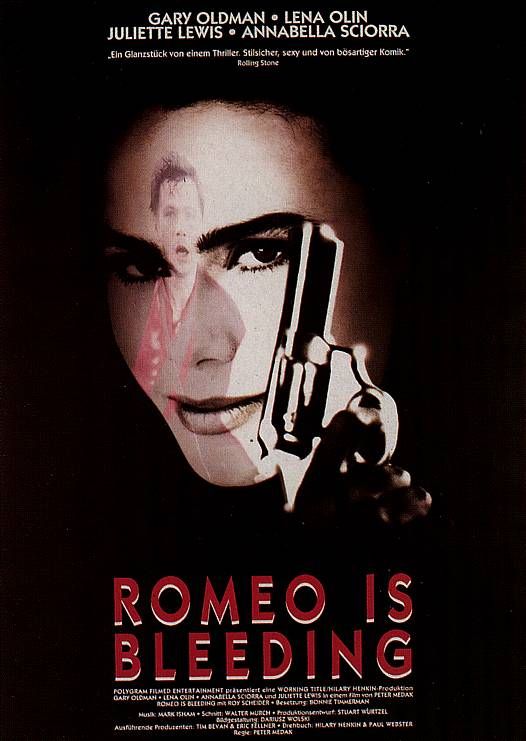

Romeo Is Bleeding is a lurid, unapologetically stylized neo-noir that lives or dies on Gary Oldman's performance, and Oldman more than carries it. Peter Medak leans hard into pulpy excess, heightened violence, and a feral, scenery-chewing Lena Olin performance as the hitwoman at the center of the chaos, and the film's willingness to go fully over the top is what makes it stick in your head. This isn't a subtle film, and it isn't trying to be one; it's a nasty, entertaining spiral of a man's greed and cowardice catching up with him in increasingly grotesque ways.
Oldman plays corruption and self-pity better than almost anyone, and his detective is a pathetic, weirdly fascinating protagonist to watch unravel across the runtime. Lena Olin matches him scene for scene, turning what could have been a one-note femme fatale into a live wire you can't predict from scene to scene. The film's reputation has always been divisive, and it's easy to see why: the tone swings wildly, and its treatment of its characters hasn't aged evenly. But as a showcase for two actors throwing themselves at material this pulpy without a shred of self-consciousness, it's hard to look away.
Gary Oldman at his most gloriously unhinged, in a noir that matches his energy.
Recommend this to fans of go-for-broke neo-noir who want performances bigger and stranger than the genre usually allows, rather than to anyone looking for a tightly controlled, respectable crime drama. It's the kind of film that's become a cult favorite less for its plotting than for how far its two leads are willing to go, and Oldman's work here is worth the price of admission on its own. Go in expecting a wild ride rather than a polished classic — that's the deal here, and the film holds up its end of it. This is the sort of movie that earns its cult reputation one unhinged scene at a time.
Romeo Is Bleeding was produced by Working Title Films and PolyGram, and shot on location across New York City neighborhoods including Coney Island, Williamsburg, and Bushwick, giving the film a grubby, specific sense of place. Jon Bon Jovi wrote a song titled 'Always' specifically for the film, but pulled it from the soundtrack after an early screening, later saying the script had been strong even though he felt the finished movie wasn't. Critical reception on release was largely negative, and the film underperformed at the box office against its budget, but Gary Oldman's performance was consistently singled out as a highlight even by otherwise unimpressed reviewers.
The film has had a slow but steady critical reappraisal in the years since, with its reputation now resting almost entirely on how hard Oldman and Lena Olin swing at material that could easily have collapsed into camp. It fits naturally alongside other polarizing early-90s neo-noirs that traded restraint for maximalist style, and it rewards viewers who enjoy performances that push past naturalism into something more theatrical. For Gary Oldman completists, it's an essential, if divisive, entry, showing an actor willing to go fully unrestrained years before that became one of his signature qualities. It's not for everyone, but it's unforgettable for the people it clicks with.