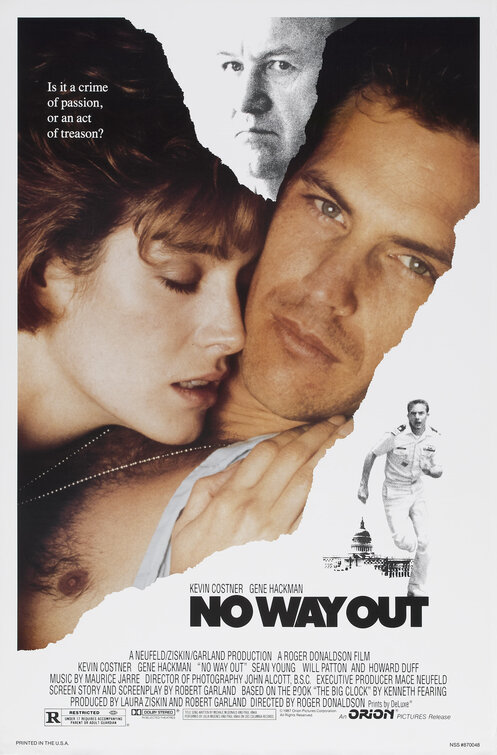
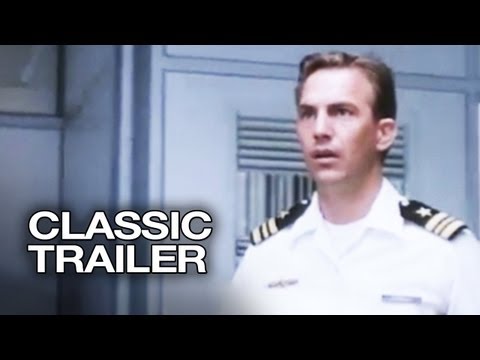
No Way Out turns a Pentagon corridor into one of the tensest spaces in 1980s American cinema, because Roger Donaldson understands that political thrillers live or die on procedural detail. Kevin Costner's Tom Farrell isn't just running from a murder charge — he's the man assigned to investigate it, which means every clue he plants to protect himself doubles as evidence against him.
Gene Hackman plays Secretary of Defense David Brice as a man who has rationalized cruelty into policy, and the performance is chilling precisely because he never raises his voice — he lets Will Patton's twitchy fixer Scott Pritchard do the panicking for him. Sean Young, as the woman caught between both men, brings a live-wire unpredictability that keeps the love-triangle scenes from feeling like mere plot mechanics.
The investigator hunting the killer is the killer — and the clock is running out.
The story traces back to Kenneth Fearing's 1946 novel The Big Clock, already filmed once in 1948 and again as the French Police Python 357 in 1976, but screenwriter Robert Garland relocated the paranoia to the Reagan-era Pentagon and gave it a Cold War twist that still lands as a gut-punch. Production shot largely around Washington D.C. on a tight three-week schedule, though the film cheats geography more than once.
Critics responded warmly on release — Roger Ebert gave it four stars — and the film holds a 92% approval rating on Rotten Tomatoes, unusually strong marks for a studio thriller built around a twist ending. It grossed roughly $35.5 million against a $15 million budget. Its lasting legacy is what it did for its leading man: this is widely credited as the role that turned Kevin Costner into a movie star.
No Way Out also picked up two Academy Award nominations of its own, for Best Cinematography and Best Film Editing, an acknowledgment of just how tightly the paranoid, corridor-bound suspense was constructed on a technical level. Composer Maurice Jarre scored the film almost entirely on synthesizers, an unusual choice that trades a conventional orchestral thriller sound for something colder and more electronic, well suited to a story about surveillance and cover-ups. Paul Anka, decades removed from his teen-idol years, performed the moody title song, and it's put to memorable use over the film's much-discussed limousine scene between Costner and Sean Young, shot on Pennsylvania Avenue in the same Washington, D.C. that the plot keeps insisting is a small, dangerous town. The party where Tom Farrell first meets Susan Atwell was filmed at the Omni Shoreham Hotel, another real D.C. location standing in for the capital's insular, incestuous political social scene, where everyone important seems to already know everyone else. It's a small reminder that No Way Out was as much a product of mid-'80s film-scoring trends as it was of Cold War-era paranoia, even as its central trap-door plot has since become a genre staple echoed by later thrillers.