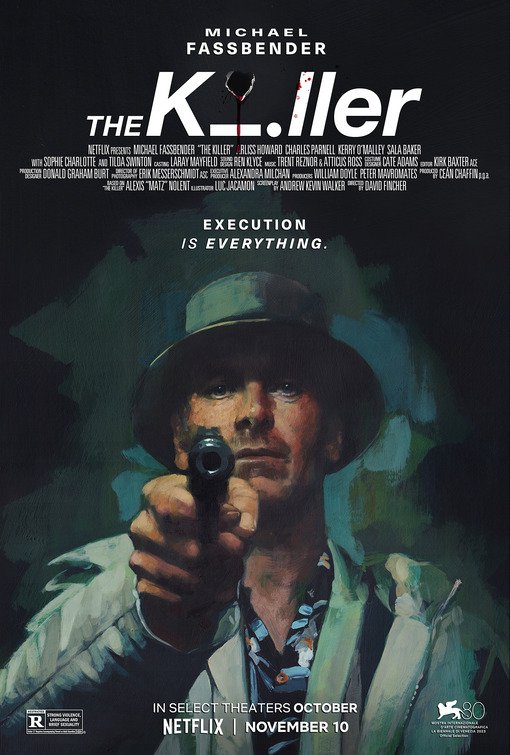

Fincher opens with twenty minutes of near-total stillness: a hitman perched in an empty office across from a hotel window, narrating his own discipline in a flat, self-satisfied drone while doing yoga stretches and eating a McDonald's breakfast sandwich. The film uses that voiceover as a running joke; every rule the Killer recites about staying invisible, staying calm, trusting no one, gets undercut the moment his aim slips and the tidy philosophy collapses. What follows isn't a revenge thriller so much as an audit: cold, procedural, almost bureaucratic in how it tracks an incompetent professional trying to restore order to his own ledger. Fassbender plays the part like a man reciting a manual to himself because he no longer believes it, which is funnier and sadder than the marketing let on.
The set pieces are sparse and deliberately anticlimactic; a hand-to-hand fight in a suburban house plays out with the grim efficiency of two people assembling flat-pack furniture, no music swells, no triumph. Fincher shoots the whole thing in cool blues and grays, treating airports, storage units, and rental cars with the same flat attention, which makes the rare bursts of violence land harder because nothing around them is dressed up to prepare you. Tilda Swinton shows up for a single extended dinner scene and steals it outright, turning what could have been a throwaway confrontation into the sharpest writing in the film. It's built on repetition and restraint, betting that watching competence curdle into doubt is more interesting than watching anyone win.
A hitman movie about a man who talks a much better game than he plays.
Viewers expecting Fincher's usual serial-killer intensity should recalibrate; this is closer to a character study of professional vanity than a conventional thriller, and it rewards patience more than adrenaline. The plot's small ironies, a man who preaches patience undone by his own impatience, land better on a rewatch, once the joke of the voiceover is fully clear. Fans of dry, procedural crime pictures, Point Blank, Le Samouraï, the more clinical end of Michael Mann, will find plenty here; anyone hoping for a shootout-a-minute revenge romp should look elsewhere entirely.
The Killer is based on the French graphic novel series of the same name, written by Alexis "Matz" Nolent and illustrated by Luc Jacamon, first published in 1998. Fincher had wanted to adapt it since the mid-2000s and originally approached Brad Pitt, who turned the project down for being too nihilistic even by the director's standards. Screenwriter Andrew Kevin Walker, who wrote Fincher's Se7en nearly three decades earlier, took over the script when the project finally moved forward at Netflix. Trent Reznor and Atticus Ross composed the score, marking their fifth collaboration with Fincher after Gone Girl, The Social Network, Mank, and Soul.
The Killer premiered at the Venice Film Festival in September 2023 before a limited theatrical run and a Netflix streaming release that November. Reviews were largely positive, with particular praise for Fassbender's performance and Fincher's control of tone, though some critics found the deadpan approach too cold to fully engage with emotionally. It went on to earn a British Academy Film Award nomination for Best Editing and reinforced Fincher's standing as one of the few directors Netflix builds prestige campaigns around. The film's mix of dry comedy and procedural violence has since drawn comparisons to Jean-Pierre Melville's Le Samouraï as a clear stylistic touchstone.