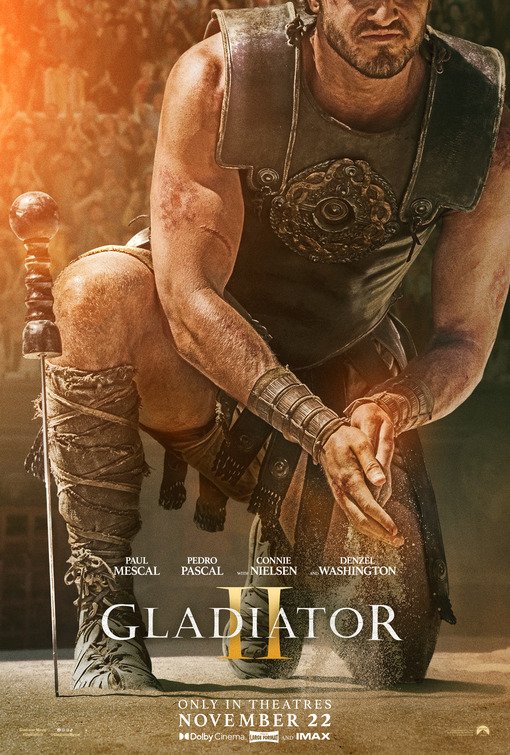
Ridley Scott doesn't try to out-muscle his own 2000 original so much as sidestep it, swapping Maximus's stoic nobility for Paul Mescal's Lucius, a man who starts the film as a colonized farmer with a grudge rather than a fallen general with a code. That shift in psychology gives the sequel its own texture: Lucius claws his way up through hatred, not honor, and Mescal plays the transformation as survival instinct more than destiny. Scott stages the action with the same appetite for scale as ever — a flooded Colosseum, a rampaging baboon troop, a rhino-mounted duel — but he's smart enough to let the palace intrigue breathe between set pieces.
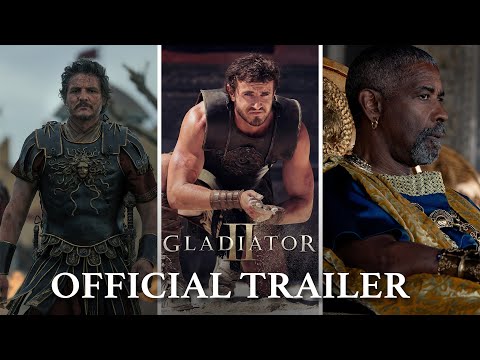
The real engine of the film is Denzel Washington's Macrinus, an arms dealer turned kingmaker who treats the empire's rot as a business opportunity rather than a tragedy. Washington plays him loose and almost gleeful, needle-dropping one-liners between manipulations, and he steals scenes from a cast that includes Pedro Pascal's weary general Acacius and a pair of preening, unhinged co-emperors in Joseph Quinn and Fred Hechinger. Scott lets those two overplay Geta and Caracalla to the point of grotesque comedy, which sharpens the film's cynicism about power passing to the unworthy instead of the capable.
A revenge epic that trades Maximus's nobility for something hungrier, meaner, and just as watchable.
Some of that scale came from stubbornness: Scott built three full-size warships that could move under their own power for the naval Colosseum battle rather than faking it digitally, and reused the repainted ramparts from his own Kingdom of Heaven, shot in Morocco two decades earlier, for the coastal siege that opens the film. Mescal, bulking up on a steady protein diet for the physical role, pushed himself hard enough during the desert fight choreography to flirt with heat exhaustion. Production shut down for five months during the 2023 industry strikes, then resumed in Malta and the UK to finish the year-plus shoot.
Critics landed on Gladiator II as a handsome, competently staged spectacle rather than a match for its predecessor, with Rotten Tomatoes settling in the high 70s and Metacritic closer to the mid-60s — the kind of split that reads as well made but less essential. It still opened as one of November 2024's biggest releases. Whatever its shortfalls next to the original, it's a rare studio sequel willing to change its hero's whole moral shape instead of recycling the arc, and Washington's performance alone justifies the runtime.
The sequel's price tag dwarfed the original's: Gladiator II reportedly cost somewhere in the $250 million range once overages are included, compared to the roughly $103 million spent on the 2000 film, a scale increase that shows up in every frame of the naval Colosseum battle and the rhino duel. That price also raised the bar for what counted as a win. The film did eventually pass the original's $451 million lifetime gross, closing in around $454 million worldwide, but with a marketing spend estimated near $100 million on top of production costs, most analysts pegged its real break-even point closer to $600 million, meaning the sequel's headline-grabbing box office total told a rosier story than the studio's actual math.