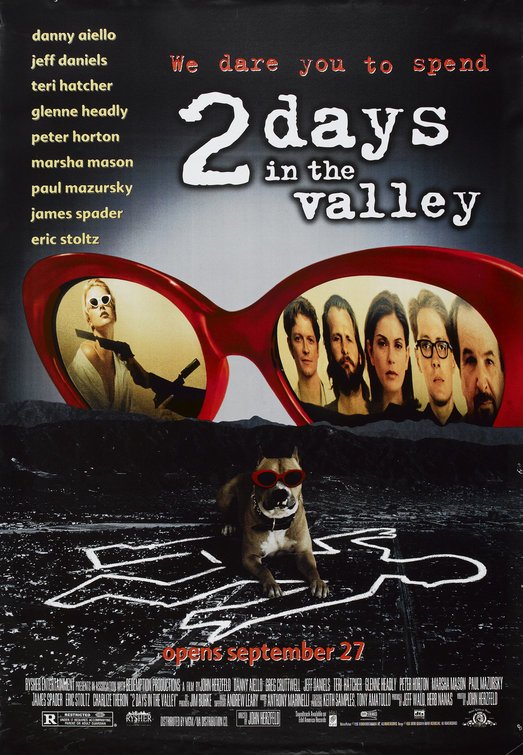
2 Days in the Valley is a lesser-known cousin of the mid-90s ensemble-crime-comedy wave that Pulp Fiction kicked off, and it's a genuinely fun ride if you enjoy watching a big cast of character actors get tangled together over one chaotic day. Danny Aiello brings real weight and even melancholy to a role that could've been a stock hitman, while Jeff Daniels and Teri Hatcher get to be funnier and stranger than either usually gets to be elsewhere. Writer-director John Herzfeld juggles a lot of plates, and not every one lands, but the film moves with enough energy and confidence that the seams rarely show.
What makes it worth seeking out is the tone: this is a crime movie that treats violence with a shrug and treats its characters' small humiliations and grasps at redemption as the real subject. Roger Ebert put it well when he noted crime here is the medium rather than the message, and that's the right way to watch it — as a hangout movie that happens to have guns in it, rather than a plot-driven thriller. It's not a masterpiece and it knows it, content instead to be a loose, funny, occasionally moving snapshot of Los Angeles eccentrics colliding for one day.
A loose, funny ensemble crime comedy that's more hangout movie than thriller — and better for it.
Recommended for anyone who likes their crime stories loose, funny, and stuffed with recognizable faces rather than tightly plotted — this is comfort-food ensemble filmmaking from a period when studios still made mid-budget movies like it regularly. It's a product of its moment, with a rock-flavored score and a very 1990s sense of cool, but that's part of the charm rather than a knock against it. Go in expecting vibes over plot mechanics and you'll have a good time; go in expecting a tightly wound thriller and you might come away less satisfied than the cast list alone suggests.
Based on a screenplay by writer-director John Herzfeld, 2 Days in the Valley assembled a deep ensemble cast including Danny Aiello, Jeff Daniels, Teri Hatcher, James Spader, Charlize Theron in an early breakout role, Glenne Headly, Peter Horton, and Paul Mazursky, released by Rysher Entertainment in 1996. The story weaves together roughly a dozen overlapping characters across a single day in and around Los Angeles's San Fernando Valley, in the ensemble-crime tradition popularized two years earlier by Pulp Fiction. Composer Jerry Goldsmith initially wrote a full orchestral score for the film, but it was replaced in post-production by a rock-oriented score from Anthony Marinelli; Goldsmith's rejected score was eventually released in complete form by Intrada Records in 2012.
Reviews at the time were mixed-to-positive, with the film sitting around 60 percent among critics, and Roger Ebert gave it three out of four stars, describing it as a movie where crime functions as the medium rather than the message. Teri Hatcher received a Golden Raspberry nomination for Worst Supporting Actress for her work here combined with her role in Heaven's Prisoners the same year, an odd footnote given the more favorable overall critical response to the film. It grossed around $11 million at the box office, a modest result that has since made it more of a cult curiosity than a widely remembered title, despite an ensemble cast full of recognizable names now more famous than they were in 1996.