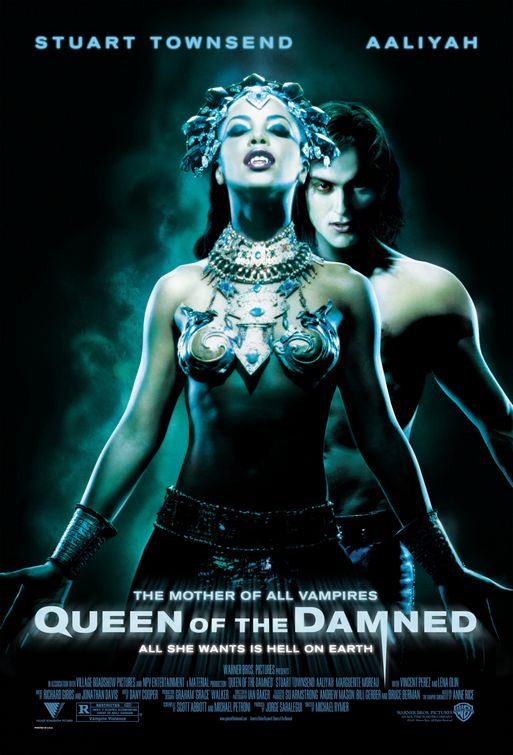
Lestat wakes up after decades of dormancy and decides the modern move for a vampire is to become a rock star, which promptly draws the attention of every older vampire who'd rather he stayed hidden, including the ancient, awakened queen Akasha. Michael Rymer folds a chunk of Anne Rice's sprawling mythology into a compressed, glossy package that trades the novels' density for music-video style and a lot of eyeliner.
Stuart Townsend plays Lestat with more smirk than menace, and the film is at its most fun when it just leans into the theatrical excess rather than fighting it. But the reason to actually watch this one is Aaliyah as Akasha, commanding, eerie, and completely aware of the camera in her only starring film role before her death shortly after filming wrapped, which gives every one of her scenes an extra weight the script alone doesn't earn.
One performance carries the whole thing on pure screen presence alone.
It's messy, it simplifies a much richer book series down to its shiniest surfaces, and it doesn't entirely hang together as a story. But a 3.3 and a 56% are fair for a movie that's more interesting as a time capsule and a showcase than as a coherent adaptation, and Aaliyah's performance alone makes it worth the ninety-odd minutes.
Queen of the Damned adapts elements of Anne Rice's Vampire Chronicles novels, following on loosely from Interview with the Vampire, with Stuart Townsend taking over the role of Lestat and Aaliyah cast as the ancient vampire queen Akasha. Production was already underway when Aaliyah died in a small plane crash in August 2001, and the film was completed and released posthumously the following year, giving her performance an added layer of poignancy for audiences and critics alike. Reviews at the time were largely unfavorable toward the film as a whole, but Aaliyah's screen presence in the title role was frequently singled out as a highlight.
Today, Queen of the Damned is remembered less for its adaptation of Anne Rice's source material than as a bittersweet document of Aaliyah's talent and star power just before her death, and it retains a devoted following among her fans for that reason. It also sits within the wave of early-2000s gothic vampire cinema that helped keep the genre popular ahead of the Twilight era, making it an interesting watch for anyone curious about that stretch of vampire-movie history. Viewers expecting a faithful Anne Rice adaptation may be disappointed, but as a moody, music-driven horror-fantasy it has its own cult appeal.
Critics were much rougher on it at the time than we are now, with Rotten Tomatoes settling at a brutal 17% against a $35 million budget that clawed back $45.3 million worldwide — a soft return, but enough to avoid outright flop status. What has aged far better is the score: Korn frontman Jonathan Davis co-wrote the soundtrack with Richard Gibbs, and when his own record contract barred his voice from appearing on the album, he called in a murderers' row of nu-metal and rock vocalists, including Chester Bennington, Marilyn Manson, David Draiman, and Wayne Static, to sing lead on the tracks instead. It is, by wide agreement, the one piece of the production that fully lands.