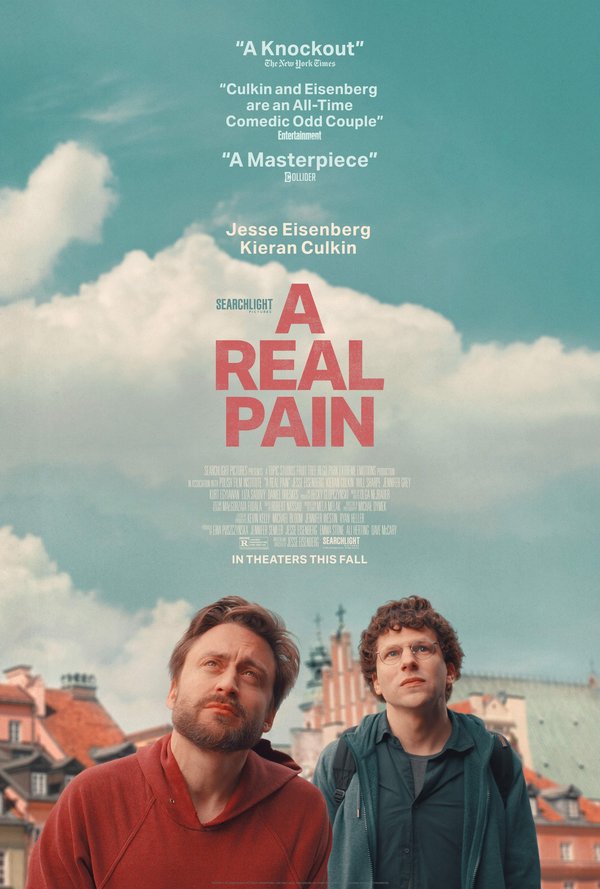

Jesse Eisenberg directs himself as the tightly wound David, paired against Kieran Culkin's Benji, a man who charms every stranger on the tour bus while quietly falling apart in private. The dynamic is the whole movie, and it works because Culkin plays Benji as authentically magnetic rather than merely draining — you understand why strangers are drawn to him within his first monologue, and you understand why living with him would wear you down within his second. Eisenberg's direction stays out of the way of that chemistry, letting scenes run a beat past the joke so the discomfort has room to land.
The comedy here is conversational rather than staged: a strained group dinner, a tour guide's well-meaning speech interrupted at exactly the wrong moment, the specific awkwardness of grief tourism when half the group is more interested in the hotel breakfast than the memorial. Eisenberg doesn't let the historical weight of the trip flatten the humor, and he doesn't let the humor make light of the history either — the film keeps both plates spinning without either one crashing.
A road-trip comedy that keeps finding the joke inside the grief and vice versa.
What lingers isn't the eventual visit to the concentration camp, though that sequence is handled with real restraint, but a quieter scene near the end where David finally says the thing about his cousin he's been avoiding the whole trip. It's a small, precise piece of writing in a film that mostly lets its actors do the heavy lifting, and it's proof Eisenberg understood how little plot a two-hander like this actually needs, which is almost none.
A Real Pain is the second feature written and directed by Jesse Eisenberg, who also produced and stars opposite Kieran Culkin. It was shot on location in Poland, with the cousins' guided tour retracing real historical sites, and Eisenberg has said the project was loosely inspired by his own family's history and a heritage tour he once took. The film is a Poland–United States co-production, distributed by Searchlight Pictures, and runs a tight 90 minutes. It premiered at the Sundance Film Festival on January 20, 2024, before a wider theatrical release that November.
Kieran Culkin won the Academy Award, BAFTA, Golden Globe, and Critics Choice Award for Best Supporting Actor for his performance as Benji, while Eisenberg's screenplay earned an Oscar nomination and the Waldo Salt Screenwriting Award at Sundance. The film was named one of the year's ten best by the National Board of Review and the American Film Institute. Its reputation has settled less around box office than around Culkin's performance specifically, which critics singled out as a career-best turn and which effectively relaunched him as a leading dramatic actor after years mostly known for comedic and ensemble television work.
Eisenberg has said the cousins' late grandmother is drawn from his own great-aunt Doris, who fled Poland for the United States in 1938 and died in 2019 at the age of 106; her death is part of what sent Eisenberg digging into his family's Polish history in the first place, well before the film became a script. The connection didn't end at the premiere: in the wake of the film's awards run, Eisenberg was granted Polish citizenship, a real-world coda to a story about reclaiming a fractured, half-known ancestry. It's the kind of detail that makes the film's warmth feel earned rather than performed — this wasn't a screenwriter borrowing someone else's trauma for material, it was somebody working through his own.