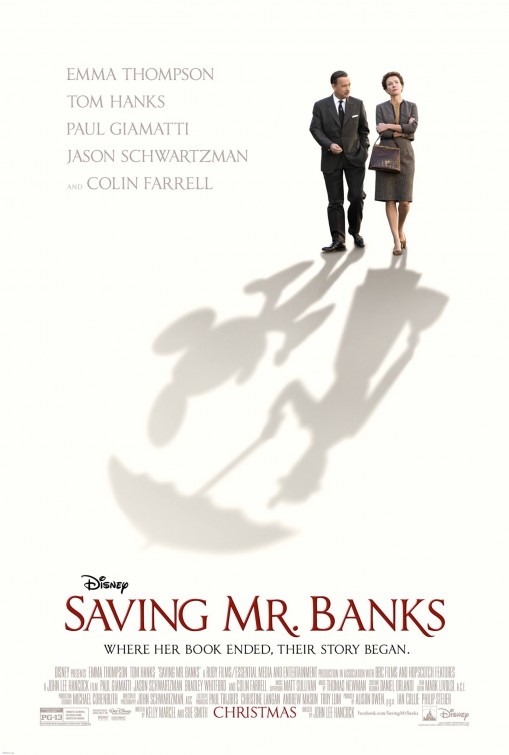
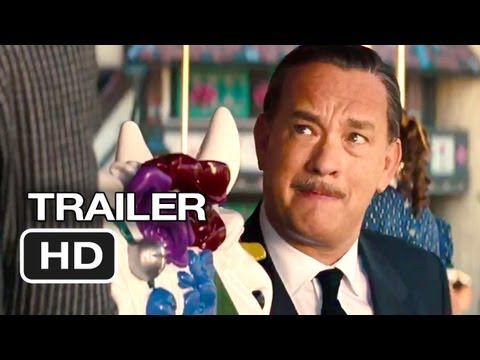
Emma Thompson plays P.L. Travers, the fantastically prickly author who spent two decades refusing Walt Disney the film rights to Mary Poppins before finally, reluctantly, flying to Los Angeles to argue every single creative decision in person. Tom Hanks plays Disney as a man who has never once heard the word no and doesn't intend to start now. Watching these two immovable objects negotiate is most of the film's pleasure.
What keeps it from being a straightforward charm offensive is the parallel story running underneath, flashbacks to Travers's childhood in rural Australia with her beloved, unreliable father, played by Colin Farrell. Those scenes explain exactly why Mary Poppins isn't a whimsical children's story to her but something closer to a rescue mission, and they give Thompson's brittleness real weight instead of making her simply the movie's obstacle to charm through.
Two people who've never lost an argument, forced to actually have one
It's a Disney movie about Disney making a Disney movie, so don't expect it to interrogate the man too hard, but Thompson's performance and the father-daughter material earn the tears it's clearly angling for. 4.3 ears and 76% worth your time reflects a genuinely well-built prestige drama that knows exactly which scenes are doing the work.
Saving Mr. Banks dramatizes the period in 1961 when author P.L. Travers traveled to Los Angeles to work with Walt Disney's studio on the film adaptation of Mary Poppins, a project Disney had reportedly been pursuing for roughly two decades. Director John Lee Hancock cast Emma Thompson as Travers and Tom Hanks as Disney, with Thompson reportedly studying real recorded story-conference tapes between Travers and the Sherman brothers to shape her performance. The film also intercuts present-day scenes with flashbacks to Travers' childhood in Australia, tying her resistance to the adaptation to real biographical material about her father.
As a Walt Disney Pictures production about the making of one of the studio's own most beloved films, Saving Mr. Banks walks a deliberate line between affectionate studio myth-making and a more clear-eyed look at Travers' guardedness and grief. It was notable at the time as one of the studio's first straightforward dramas to carry a PG-13 rating rather than family-friendly G or PG. It tends to appeal most to classic-Hollywood and Disney history buffs, as well as anyone who grew up with Mary Poppins and is curious about the real tension behind its creation.
The film's most Disney-fied moment might be its ending. In reality, Travers wasn't even invited to the 1964 Mary Poppins premiere and showed up anyway, and while she did cry that night, her own later letters suggest it was out of anger rather than the swelling, moved-to-tears reconciliation Saving Mr. Banks stages for her. She reportedly pushed back on Disney about the animated penguin sequence and other liberties taken with her book, and by most accounts never made peace with what the studio had done to it, refusing to authorize another adaptation for the rest of her life. That's part of why Mary Poppins Returns didn't arrive until 2018, more than two decades after her 1996 death. It's a fitting irony: Saving Mr. Banks is, structurally, still a Disney production softening its own history even while dramatizing a woman fighting Disney to protect hers.