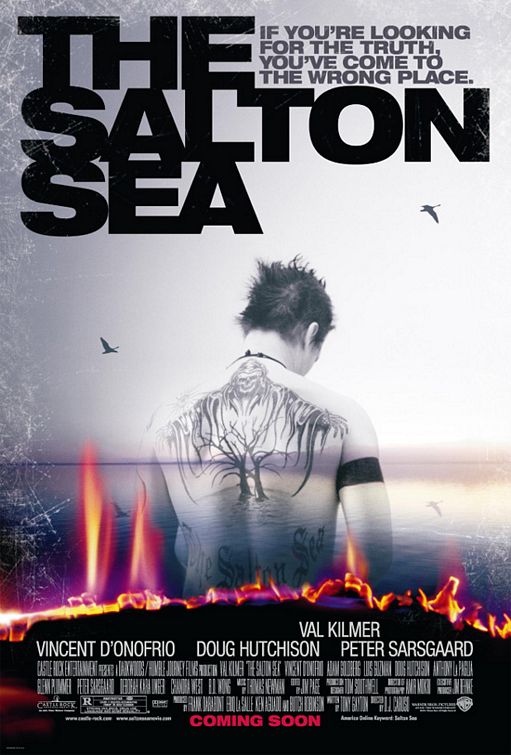

Val Kilmer plays Danny Parker/Tom Van Allen, a police informant embedded deep in Southern California's meth-cooking underworld, secretly working an angle connected to his wife's unsolved murder. Director D.J. Caruso and a game supporting cast — including Vincent D'Onofrio as a nose-less, terrifying meth kingpin and Peter Sarsgaard as Kilmer's tweaked-out best friend — build a world that's grimy, jittery, and constantly threatening to spin out of control.
The nonlinear structure and jumpy narration owe an obvious debt to the crime cinema of the era, but Kilmer's performance is the reason it sticks — twitchy, sad, and quietly wrecked underneath the double-crosses. D'Onofrio in particular goes somewhere genuinely unhinged, and the film lets its supporting cast get weird in ways a more cautious script would have reined in.
Grief, meth, and revenge make for a genuinely unhinged combination.
The Salton Sea is scrappier and messier than its noir contemporaries, and that's part of its appeal — it feels lived-in rather than polished, closer to a fever dream than a procedural. It doesn't reach the very top tier of the genre, but as a showcase for Kilmer at his most committed, it's well worth the runtime.
The Salton Sea marked the feature directing debut of D.J. Caruso, working from a screenplay by Tony Gayton that mixes twisty neo-noir plotting with darkly comic, almost surreal touches. Val Kilmer took the lead as a man living a double life in the meth-fueled underworld around California's Imperial Valley, supported by a colorful ensemble including Vincent D'Onofrio as the drug dealer Pooh-Bear and a young Peter Sarsgaard. Produced under Castle Rock Entertainment and released through Warner Bros. in 2002, the film arrived with little fanfare, opening in a small number of theaters and barely registering at the box office against its budget.
Despite that quiet theatrical run, The Salton Sea found new life on home video, where its bruised, stylized visuals and go-for-broke performances built it a lasting cult reputation. Critics at the time were mixed, but retrospective appreciation has grown, with many now singling it out as one of the more underrated entries in Val Kilmer's filmography and an early sign of D.J. Caruso's visual confidence before he moved into bigger studio thrillers. It sits comfortably alongside other early-2000s neo-noirs that lean into pulpy excess, and it tends to reward viewers drawn to grimy, character-driven crime stories over slicker genre fare.
The numbers back up just how quietly this one came and went: The Salton Sea opened on a reported $18 million budget and grossed just over $1 million domestically, a result about as far from breakout as a studio-adjacent release gets. Critics were kinder than the box office suggested, though, ultimately settling the film at a 63% approval rating on Rotten Tomatoes across more than 80 reviews. Roger Ebert was among the more enthusiastic, awarding it three out of four stars and singling out a quiet scene of Kilmer's character tenderly caring for an abused neighbor as proof there was real feeling buried under all the grime and double-crosses.