
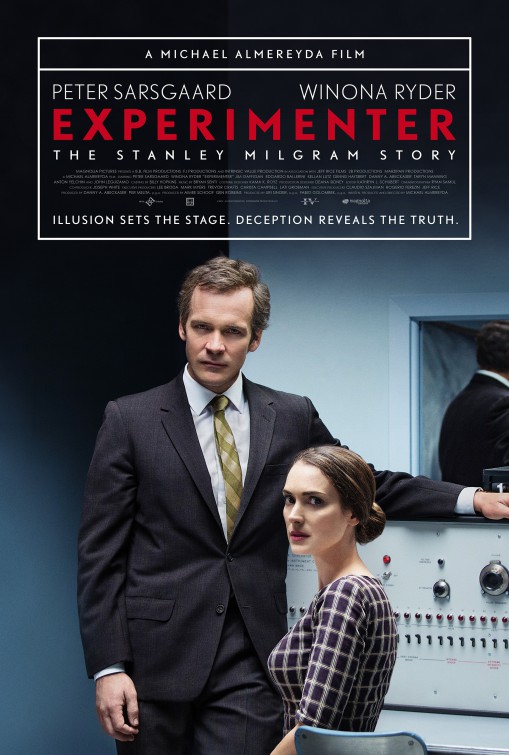

Peter Sarsgaard plays Stanley Milgram, the psychologist whose 1961 obedience experiments, ordinary volunteers pressured into delivering what they believed were painful electric shocks to a stranger, became one of the most cited and most argued-over studies in the field. Michael Almereyda doesn't restage them as pure shock theater, he treats them as the opening chapter of a much stranger, more personal story about what it costs to become famous for proving something people didn't want to hear.
The film keeps breaking its own realism on purpose, an elephant walks through the background of a scene, Sarsgaard turns and narrates straight to camera, and it works because Milgram's whole career was about the gap between what people say they'd do and what they actually do under pressure. Winona Ryder, as his wife, and Jim Gaffigan add warmth without ever letting the film go soft on its subject's complications.
The gap between what people say they'd do and what they actually do, dramatized.
It's a biopic that trusts you to sit with ambiguity rather than handing you a clean verdict on its own protagonist, which is exactly right for a man whose legacy is still argued about. A 4.0 and a 70% feel appropriate for something smarter and stranger than the textbook summary you probably already know, and more human than its subject usually gets credit for.
Experimenter takes a formally unusual approach to the biopic genre, with director Michael Almereyda having Peter Sarsgaard's Stanley Milgram narrate directly to the audience and walk through obviously artificial studio backdrops, a stylistic choice meant to echo the theatrical, almost performative nature of Milgram's own experiments. The film covers not just the famous obedience studies but touches on Milgram's broader academic career and public reception, including the backlash he faced over the ethics of his methods. It premiered at the Sundance Film Festival and received a limited theatrical release, with reviews praising Sarsgaard's controlled performance and the film's intellectual ambition even where some found its stylization distancing.
Because it deals directly with one of psychology's most famous and most debated studies, Experimenter tends to appeal strongly to viewers already curious about the real Milgram experiments, offering more nuance than the pop-culture shorthand version of 'people will do anything if told to by an authority figure.' It pairs well with other cerebral, formally adventurous biographical dramas rather than conventional prestige biopics, and its willingness to sit with uncomfortable questions about obedience and complicity gives it a lingering, thought-provoking quality that has helped it develop a modest cult following among psychology-minded film fans.
The fourth-wall-breaking style extends into an unusually layered meta-joke: partway through, Almereyda restages a scene from The Tenth Level, the real 1976 TV movie that dramatized Milgram's experiments, complete with Kellan Lutz playing William Shatner playing Milgram, while Sarsgaard's actual Milgram looks on from the set. It's a strange, funny bit of doubling that captures the film's whole thesis about performance and self-presentation better than a straight recreation ever could. Critically, Experimenter landed further from divisive than its unconventional style might suggest, holding around 85% on Rotten Tomatoes and a Metacritic score in the low 80s, with most reviewers singling out Sarsgaard's controlled, faintly amused voiceover as the film's anchor.