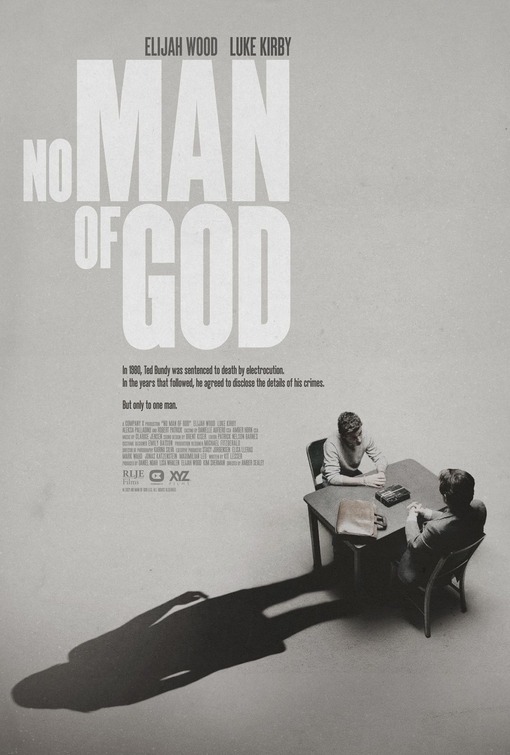

No Man of God earns its tension from restraint rather than reenactment — writer C. Robert Cargill and director Amber Sealey aren't interested in restaging Bundy's murders, which barely register onscreen. Instead the film locks itself in a series of prison rooms and lets two actors talk. That's a risky bet for a genre built on shock value, but it pays off because both performances hold the tension of a chess match. Luke Kirby plays Bundy as charming right up until he isn't, modulating from wounded self-pity to cold manipulation within a single sentence, while Elijah Wood's Hagmaier absorbs it all with the strained patience of an interrogator who understands how dangerous politeness can be.
Kirby's Bundy is the film's real achievement, a performance built less on movie-serial-killer tics than on the unsettling ordinariness that made the real Bundy so effective at manipulating people. He plays up Bundy's self-mythologizing — the pseudo-intellectual asides, the insistence on discussing himself in the third person — without letting the film treat any of it as insight rather than performance. Wood, working almost entirely through reaction, gives Hagmaier a moral exhaustion that deepens across the film's timeline; you watch a professional's clinical detachment erode session by session, replaced by something closer to disgust at his own reluctant investment in keeping this man talking.
Two men in a concrete room, and the scariest thing onscreen is how reasonable one of them sounds.
The dialogue carries an unusual weight of authenticity because so much of it is drawn from the real record. Cargill, writing under the pseudonym Kit Lesser, built the script from actual transcripts, tape recordings and Hagmaier's own recollections of more than 200 hours of death-row conversations he had with Bundy between 1984 and 1989. Hagmaier himself consulted on the production, which is presumably why the film resists the urge to turn its subject into a mythic monster — the whole point of Hagmaier's approach, on the tapes and in the film, was treating Bundy as a manipulator to be out-strategized rather than a boogeyman to be feared.
Critics responded to the film's two-hander discipline more than its structure — it's sitting around 80% on Rotten Tomatoes, with the consensus praising the performances even while noting the film doesn't reinvent the Bundy true-crime formula. Roger Ebert's site called Kirby's performance possibly the best screen Bundy yet, magnetic without tipping into spectacle. Arriving amid an oversaturated wave of Bundy media, including Zac Efron's higher-profile 'Extremely Wicked, Shockingly Evil and Vile,' No Man of God distinguishes itself by having almost no interest in Bundy's crimes and total interest in his psychology, which ends up being the more disturbing choice.
The film had its world premiere at the Tribeca Festival in June 2021 before RLJE Films took it into a modest theatrical and VOD release that August, which is about the right-sized rollout for a movie built on dialogue rather than spectacle. Kirby was already known to prestige-TV audiences for a very different kind of talky two-hander performance, having won an Emmy for playing Lenny Bruce opposite Rachel Brosnahan on The Marvelous Mrs. Maisel, and he brings some of that same coiled, magnetic unpredictability to Bundy. It is a strange resume pairing, comedian and killer, but it is exactly the kind of range that makes the casting here feel inspired rather than stunt-like.