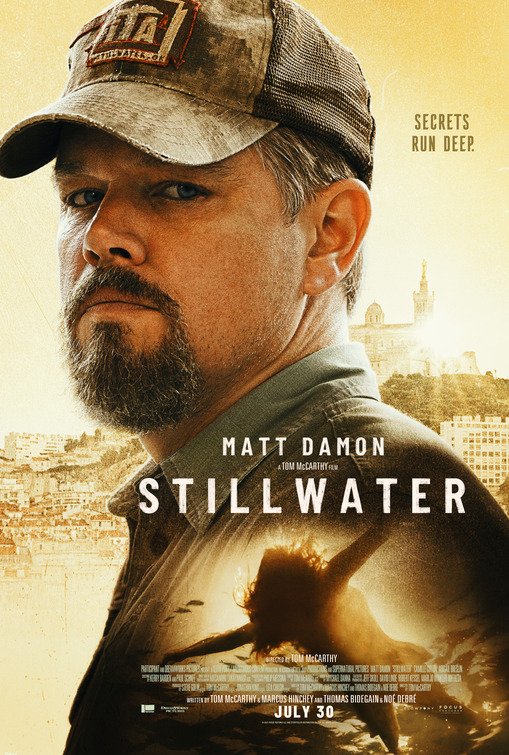

Bill Baker is an Oklahoma oil-rig worker whose daughter has spent years in a French prison for a murder she insists she didn't commit, and when a new lead surfaces, he flies to Marseille to chase it down himself, however unqualified he is for the job. Matt Damon plays him as quiet, stubborn, and out of his depth in a country whose language and rules he barely understands.
The film is less interested in courtroom twists than in the slow, awkward work of Bill building a life in Marseille — the neighbors he leans on, the woman played by Camille Cottin who takes him in, the daughter played by Abigail Breslin who isn't sure she wants his help. It's a character study wearing the clothes of a thriller, patient where you'd expect urgency.
Stillwater trusts a quiet performance to carry weight most thrillers would shout about instead.
Damon underplays every scene, letting the frustration and guilt show through small gestures instead of speeches, and it's some of the most understated, effective work of his career. The pacing will test viewers expecting a straightforward exoneration plot, and it swerves in directions that won't sit well with everyone. But as a portrait of a flawed father trying, clumsily and sincerely, to fix what he can, it holds up.
Stillwater was directed by Tom McCarthy, the filmmaker behind Spotlight and The Station Agent, and was loosely inspired by the real case of Amanda Knox, the American student wrongfully convicted of murder in Italy before eventually being exonerated. The filmmakers relocated and heavily fictionalized the story, shifting it to Marseille, France, and building an entirely fictional central case and family dynamic around the premise. Knox spoke out against the film after its release, saying it profited from her story without her involvement and reinforced public perceptions of her guilt. Production shot on location in both Oklahoma and southern France, and the film premiered at the 2021 Cannes Film Festival.
Critics responded warmly to Matt Damon's lead performance as a blue-collar father navigating a foreign country and legal system he doesn't understand, even as some found the film's late plot turns less convincing than its slow-burn character study opening. It sits naturally alongside McCarthy's other work, which consistently favors quiet, character-driven drama over conventional thriller mechanics. For viewers drawn to grounded, performance-first dramas about family, class, and cultural displacement, Stillwater offers a patient, morally complicated story anchored by one of Damon's more understated performances.
Stillwater underperformed commercially, pairing a reported $20 million budget with a domestic gross that barely cleared $19.8 million, numbers that made it one of the more overlooked awards-adjacent dramas of that summer despite a respectable Rotten Tomatoes score in the low 70s. McCarthy shares screenplay credit with Marcus Hinchey and the French writing duo of Thomas Bidegain and Noé Debré, whose credits include Dheepan and A Prophet, which likely explains why the Marseille half of the film feels observed rather than tourist-eyed. At its Cannes premiere, Damon reportedly teared up during a lengthy standing ovation, a warmer reception than the film's muted box office would suggest, and one that lines up with how much more attention the film has found since landing on streaming.