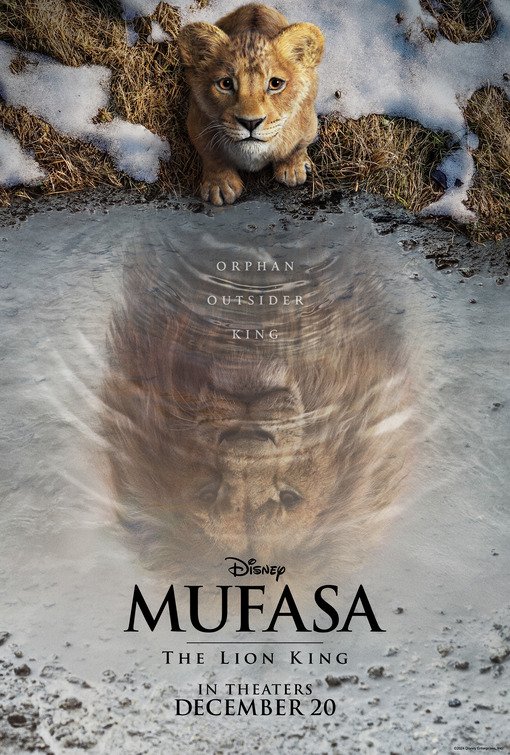
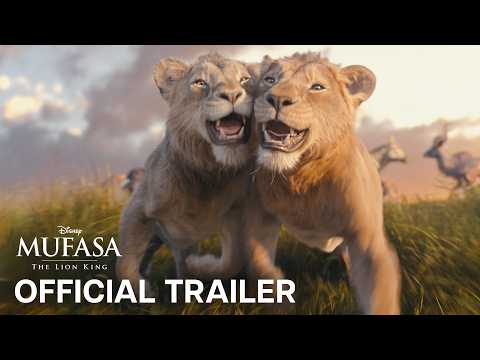
Barry Jenkins is an unusual choice to direct a photorealistic Disney prequel, and Mufasa: The Lion King is most interesting exactly where his sensibility pushes through the technical constraints — in the way he frames the young cub's exile as genuine trauma rather than a plot device, and in how patiently the film lingers on quiet, wordless stretches of the savanna. The device of Rafiki narrating the story to Kiara, with Timon and Pumbaa interrupting for comic relief, gives the film a framing structure that keeps its heavier material from feeling like a grim slog, even when the story it's telling — a brotherhood curdling into betrayal — is genuinely somber for a Disney musical.
Aaron Pierre and Kelvin Harrison Jr. voice Mufasa and Taka with real vocal chemistry, and the songs, mostly newly composed rather than recycled from the 1994 original, give both actors room to sing rather than just narrate. Mads Mikkelsen's villainous Kiros brings a chillier, more explicitly threatening energy than Scar ever needed, since this film has to build its antagonist's menace from nothing. The photorealistic animal designs remain the franchise's persistent limitation — expressive voice work fighting against faces that can't fully convey emotion — and Jenkins's direction can only do so much to compensate for a visual style that was always going to underserve character-driven melodrama.
A brotherhood curdles into Scar's origin story, one virtual savanna sunset at a time.
Jenkins shot the film using the same virtual-production toolkit Jon Favreau developed for the 2019 Lion King, working with VFX house MPC for three years without ever building a physical set — a process Jenkins later admitted 'is not my thing' and one he wants to move away from for future projects. Beyoncé reprises her role as Nala, joined by her daughter Blue Ivy Carter, who voices young Kiara; Jenkins has said Blue Ivy earned the role through a strong audition rather than family connections. The production's virtual-camera workflow let Jenkins block and light scenes as though they were live-action, a workaround for a director whose reputation was built on tactile, handheld intimacy rather than digital environments.
Critics were more divided than enthusiastic, with the film settling in the high 50s on both Rotten Tomatoes and Metacritic — reviewers generally credited Jenkins's directorial fingerprints while questioning whether the photorealistic format could ever really serve a story this emotionally driven. It nonetheless became a substantial box-office success worldwide, extending Disney's run of profitable Lion King prequels and remakes even as critical consensus cooled. Its legacy so far is less about redefining the franchise and more about proving that even a distinctive directorial voice has limits when working inside this particular technical box.