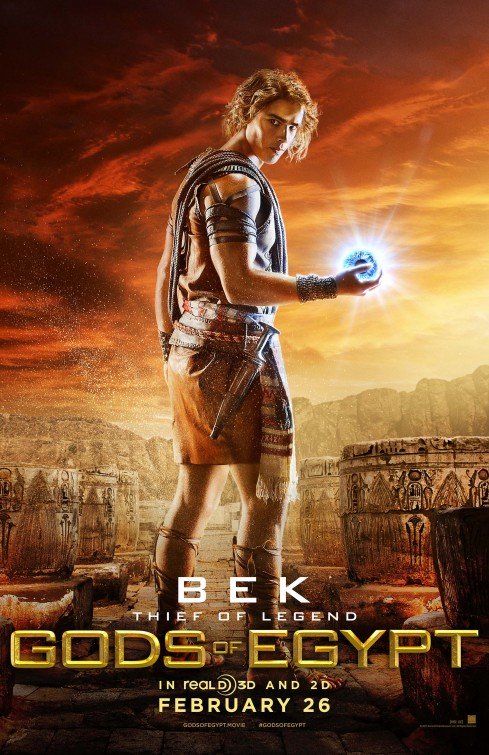

Set has murdered his brother Osiris and blinded the god Horus to seize the throne of Egypt, and now a mortal thief has to team up with the wounded Horus to get his eyes, and the kingdom, back. Alex Proyas throws every ounce of budget at towering CGI gods, sand pyramids the size of mountains, and giant snakes, and the plot exists mostly as connective tissue between one absurd set piece and the next.
Nikolaj Coster-Waldau and Gerard Butler chew through the dialogue like they know exactly what movie they signed up for, which turns out to be the correct instinct. Chadwick Boseman shows up as the god Thoth and steals scenes with pure theatrical commitment, the kind of performance that only makes sense inside something this unashamedly maximalist. Nobody here is trying to make you forget you're watching a myth mashup with a nine-figure budget.
Big, dumb, and completely sincere about it, which counts for something.
It's big, dumb, and completely sincere about being big and dumb, which is a rarer combination than it should be. A 3.2 and a 55% are honest scores for a movie with real problems, but also a movie that's genuinely entertaining to watch fall apart in the most expensive way possible, popcorn cinema that knows its own lane and stays in it.
Gods of Egypt was director Alex Proyas's attempt at a big-budget fantasy epic in the vein of Clash of the Titans, mixing ancient mythology with heavy visual effects and a cast led by Gerard Butler and Nikolaj Coster-Waldau. Filming took place largely in Sydney, Australia, with Proyas's own production company, Mystery Clock Cinema, involved alongside Thunder Road Pictures and distributor Lionsgate. Before the film even reached theaters, it became the center of a widely covered controversy over its predominantly white cast playing ancient Egyptian characters, an issue Proyas — who was born in Egypt — and Lionsgate both publicly addressed and apologized for.
Critically and commercially, Gods of Egypt landed as one of the more prominent flops of its year, failing to recoup its substantial budget and drawing largely negative reviews. Even so, it has picked up a modest so-bad-it's-fun following among viewers who enjoy maximalist, effects-heavy fantasy spectacle without worrying too much about narrative subtlety. It's best approached as campy eye candy in the tradition of other over-the-top 2010s myth epics rather than as a serious take on Egyptian mythology, and it remains a frequently cited case study in Hollywood casting controversies.
The specific math behind the flop is worth spelling out: worldwide, Gods of Egypt earned roughly $150.7 million, split between a soft $31 million domestically and about $119 million overseas, nowhere close to the $300 million-plus a movie this expensive typically needs to clear before marketing and distribution costs are counted. The film went on to collect several Golden Raspberry Award nominations, including nods for Worst Picture and Worst Director for Alex Proyas. None of that has stopped it from developing a cult afterlife as midnight-movie spectacle; if anything, the scale of the miscalculation is exactly why people still bring it up a decade later.