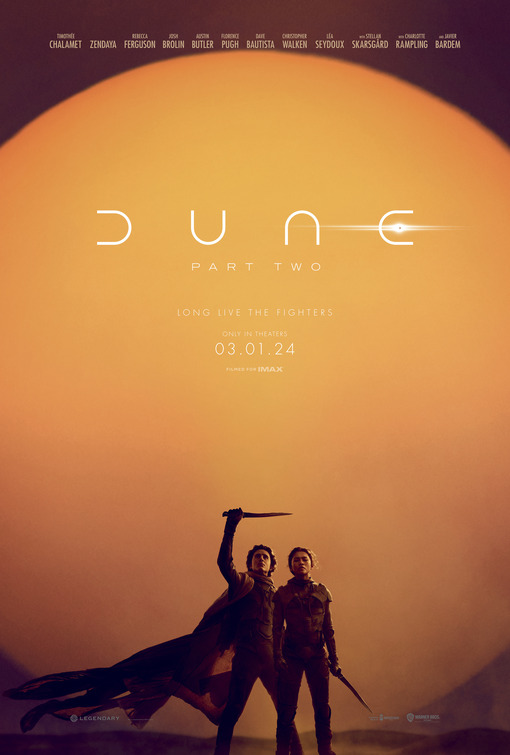

Dune: Part Two is the rare studio blockbuster that gets more skeptical of its own hero as it goes, not less — Denis Villeneuve keeps undercutting Paul Atreides' rise by reminding you it's built on manipulated religious prophecy and a coming holy war he can see and can't stop. Most franchise films would let the training-montage, chosen-one arc play straight; this one keeps cutting to Chani's growing distrust as the clearest voice of sanity in the room. That tension between spectacle and warning is what separates it from a conventional sci-fi sequel — the scale is enormous, but the film never fully lets you enjoy Paul's victory without cost attached.
Timothée Chalamet plays the shift from reluctant outsider to something colder and more messianic in increments small enough that you don't notice the change until it's already happened. Zendaya gets far more to do here than in the first film, and Chani's arc becomes the story's emotional conscience precisely because she refuses to be swept up in the prophecy everyone else buys into. Austin Butler's Feyd-Rautha, introduced in stark black-and-white cinematography under a black sun, is genuinely unsettling in limited screen time, and Villeneuve resists the urge to overuse him.
A hero's rise that plays like a warning, not a triumph.
The sandworm-riding sequence took roughly three months to film using a practical rig that violently shook actors to simulate the ride, built on a set measuring 90 by 24 feet, while the surrounding desert exteriors were filmed in Jordan's Wadi Rum, where the production built miles of temporary roads just to move equipment. Villeneuve shot the entire film with IMAX cameras to make the scale of Arrakis feel physically overwhelming in theaters rather than merely large. Steven Spielberg publicly called the sandworm sequence one of the great images in cinema history, a rare unsolicited endorsement from one blockbuster filmmaker to another.
Dune: Part Two scored 92% on Rotten Tomatoes and around 80 on Metacritic, and it more than doubled the first film's global gross, finishing north of $700 million worldwide against a reported $190 million budget. It arrived as the first genuine blockbuster hit of 2024 and reset expectations for what a mid-franchise sci-fi sequel could look like — dense, morally uneasy, and unwilling to simplify Frank Herbert's cautionary politics just to close out the trilogy's first half cleanly.
Dune: Part Two went on to win two Academy Awards, for Best Visual Effects and Best Sound, validating the scale Villeneuve chased with practical sandworm rigs and IMAX cameras. Hans Zimmer's score, oddly, wasn't in the running at all — the Academy ruled it ineligible for Best Original Score because it reused too many themes from his Oscar-winning music for the first Dune, running afoul of the rule limiting how much a sequel score can lean on previous franchise material. Zimmer was openly frustrated by the ruling, but the snub barely dented the film's awards run; the score picked up a Grammy instead, and the film's practical, effects-heavy approach became a reference point for other blockbusters chasing similarly tactile scale.