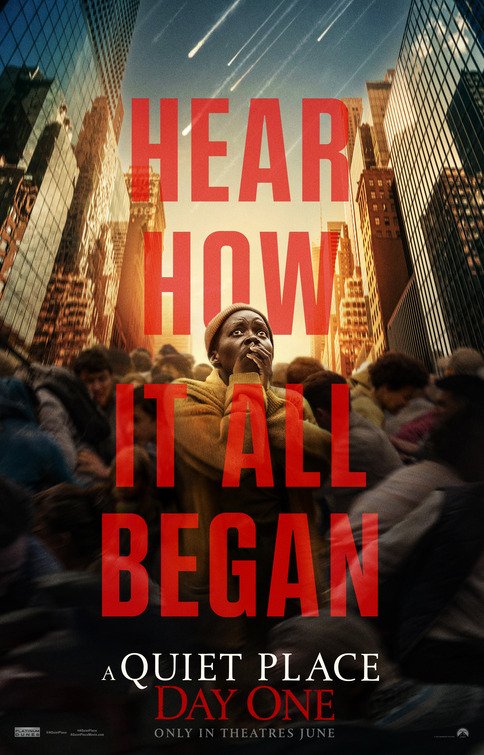
Michael Sarnoski's prequel does something the two Krasinski-directed entries never quite risked: it treats the invasion as backdrop to a specific, contained human story rather than a survival puzzle to solve. Lupita Nyong'o's Samira is dying of cancer before the aliens even arrive, and that detail reframes everything — she isn't fighting to preserve a future she doesn't expect to have, she's chasing one specific, almost absurd comfort while the city collapses around her. It's a smaller, sadder premise than "keep the family alive," and Sarnoski, who previously made the quiet, grief-soaked Pig, is clearly the right director for that register.
Nyong'o barely raises her voice above a whisper for the entire runtime and still carries every scene, playing exhaustion and dry humor in the same breath. Joseph Quinn, as a law student who latches onto her out of pure panic, works as her opposite — jumpy where she's resigned — and their reluctant partnership avoids the routine survivor-bonding beats you'd expect from this kind of setup. Sarnoski also finds new geography for the franchise: Manhattan's density becomes its own kind of horror, with crowds turning into liabilities and the subway system doubling as both hiding place and death trap. The film trusts silence as an emotional tool, not just a suspense mechanic.
A survival story that trades the family unit for one dying woman's last, stubborn wish.
Much of the New York exterior work was actually shot on a rebuilt Chinatown backlot outside London, with several disused Underground stations standing in for the closed sections of the NYC subway — a workaround that mostly goes unnoticed on screen. On a lighter note, Nyong'o was reportedly uneasy around the cat playing Samira's companion Frodo, played by two different cats, and asked the production about swapping the animal, while Quinn kept a card trick hidden from her until the actual take so her reaction to it would be real. Small choices like that thread through a film built on tactile, in-the-moment performance.
Reviews were the strongest of any Quiet Place entry, with Rotten Tomatoes settling in the mid-80s and critics singling out Nyong'o's performance as some of the best work in the franchise's history. Commercially it held its own against the original duology despite skipping the Abbott family entirely, proof that the series' sound-based premise can support stories beyond its original cast and setting. As a prequel, it functions less as scene-setting and more as a standalone tragedy that happens to explain how the world went quiet, told from a corner of it the earlier films never had time to visit.