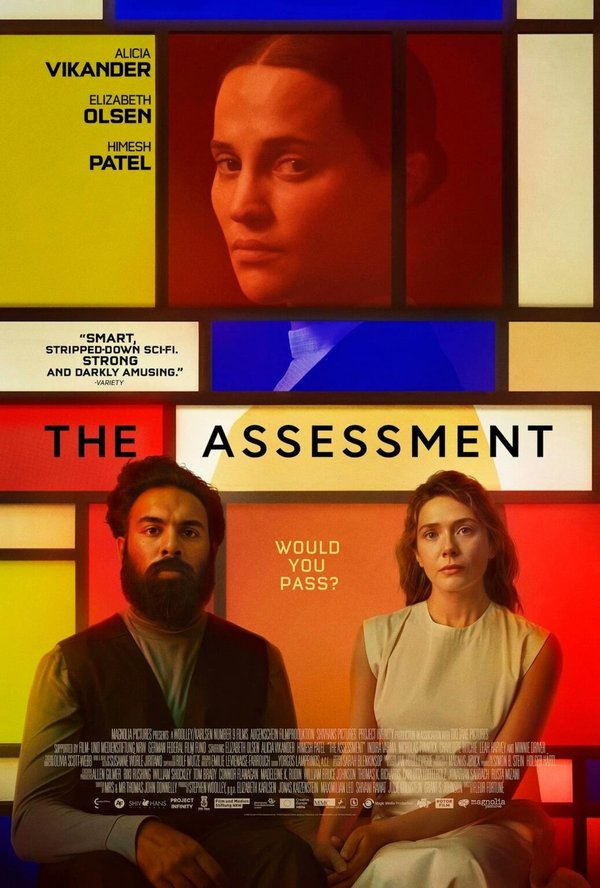
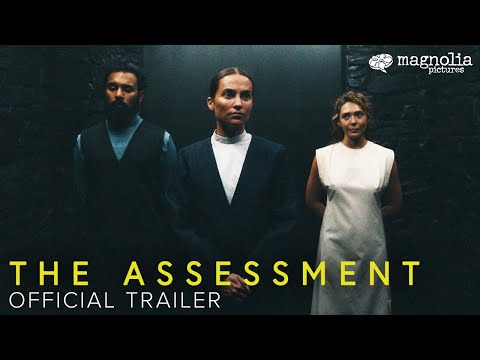
The premise is a pressure cooker by design — three people, one house, a countdown — and Fortuné directs it like she trusts the actors to do the escalating rather than the camera. Alicia Vikander plays the assessor as a shape-shifter, moving from clinical to childish to cruel within a single scene, and the film gets real mileage out of never quite letting the couple, or the audience, know which version of her is the test and which is just her.
Elizabeth Olsen and Himesh Patel play a couple whose relationship starts to fracture under observation before the assessor does much of anything, which is the smarter choice than it sounds — the film is less interested in a villain than in what surveillance does to two people who already had things they weren't saying to each other. The ecological backstory stays mostly in the margins, sketched through production design rather than exposition, and the restraint suits the story better than a lecture would have.
Three actors, one house, and a seven-day test that turns wanting a child into an interrogation.
It loses some tension in a back half that leans harder into role-play scenarios than character development, and the ending resolves more tidily than the setup earns. Still, this is a confident, ideas-forward debut in the mold of small-cast speculative chamber pieces, the kind that tends to arrive quietly and outlast louder festival premieres once people catch up to it.
The Assessment marks Fleur Fortuné's transition from music videos and commercial work into features, a background that shows in the film's controlled, image-driven approach to its single main location. It was shot as a UK-Germany-US co-production on a modest budget, and Magnolia Pictures picked it up for U.S. distribution following its Toronto premiere. The screenplay, credited to Nell Garfath-Cox, Dave Thomas, and John Donnelly, was developed around the central conceit of a state-mandated parental evaluation before the ecological backdrop was fully built out.
Reviews out of Toronto and Sitges were largely positive, with trade critics praising Vikander's performance in particular and calling it one of the more striking directorial debuts of 2024's festival circuit. It didn't get a wide theatrical push, landing instead through a more limited theatrical-then-streaming route typical of mid-budget speculative dramas, which kept it from reaching the audience its reviews suggested it deserved — the kind of film that tends to get rediscovered well after its release window closes.
When The Assessment reached general audiences, the reception matched its festival buzz: it landed at 84% on Rotten Tomatoes across nearly 80 reviews, with the site's critics consensus praising the film for investing "its high concept into ideas rather than special effects" and putting its trio of performances "under a microscope." The film also picked up a British Independent Film Award for Best Production Design, with Vikander earning a BIFA nomination for Best Lead Performance — a fitting pair of nods given how much of the film's tension is built through the house itself rather than dialogue. Not every critic was won over; a few found its clinical remove more distancing than intended. But the consensus held that this is smart, patient speculative fiction that trusts ideas over spectacle.