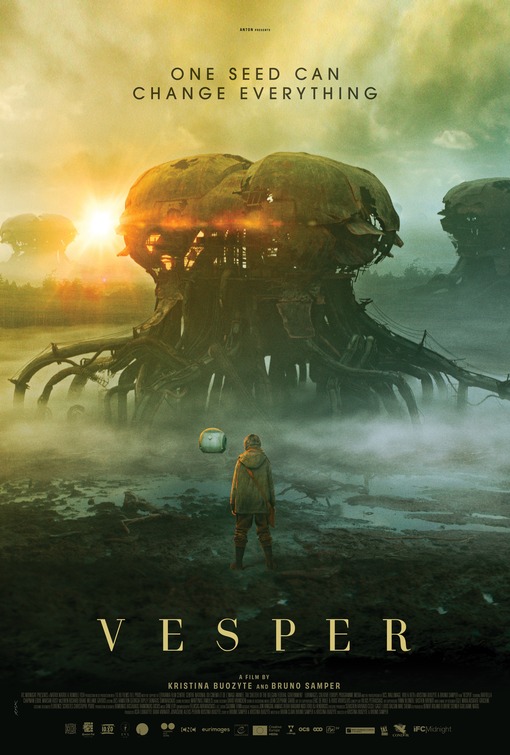

Vesper earns its reputation as one of the most visually inventive science-fiction films of the last few years, and it does that without leaning on wall-to-wall CGI. The filmmakers built a biopunk world out of practical creature design, textured sets, and startling color choices tied to its bioluminescent details, a decision that makes the world feel touchable rather than rendered. On a budget far smaller than a typical studio sci-fi picture, directors Kristina Buožytė and Bruno Samper conjure a sense of scale and strangeness that outpaces movies with far more money behind them. If you've grown tired of sci-fi that mistakes noise for wonder, this is the corrective: quiet, patient, and confident in its own imagery.
What keeps the film grounded is its cast. Raffiella Chapman carries the movie as Vesper, playing resourcefulness and loneliness without tipping into precociousness, and Eddie Marsan brings real weight to a father figure whose body has failed him but not his will. Rosy McEwen's arrival as an outsider gives the story its emotional hinge, and the performances never feel swallowed by the production design around them, a genuine risk in a film this visually ambitious. It's the kind of restrained, character-first acting that lets the world-building breathe instead of shouting over it, and it's a big part of why critics responded to the film as more than just a technical showcase.
A biopunk fairy tale that proves imagination beats budget every time.
Recommend this to anyone who wants their science fiction thoughtful rather than loud. Viewers drawn to the atmosphere of Annihilation or the scrappy inventiveness of low-budget European genre films will find plenty to like here. It isn't built for spectacle in the blockbuster sense; it rewards patience and close attention to its ecosystem of ideas about survival, biology, and inheritance. The pacing is deliberate, which won't suit everyone looking for a fast ride, but for viewers who want a science-fiction film that trusts its ideas and its images, Vesper is a genuine find, a rare case of ambition and execution actually meeting in the middle.
Vesper is a genuine three-country co-production, made across Lithuania, France, and Belgium, with lead production company Natrix Natrix based in Vilnius. Filming took place in Lithuania, and a lengthy development process gave directors Kristina Buožytė and Bruno Samper, previously behind 2012's Vanishing Waves, time to work out a visual approach built on practical effects rather than digital spectacle. The production used no green screen, leaning instead on physical creature work, textured sets, and in-camera lighting inspired by the compositions of painters like Vermeer and Rembrandt. The film premiered at the Karlovy Vary International Film Festival in July 2022 and went on to earn strongly favorable reviews from critics, who singled out its world-building as remarkable for its scale of ambition.
Vesper sits in a small but distinctive lineage of post-apocalyptic biopunk cinema that treats ecological collapse as body horror as much as landscape horror, stories where survival is written into flesh and seeds as much as ruined cities. It has earned comparisons to earlier European art-house science fiction more than to mainstream studio franchises, and critics have consistently pointed to its visual imagination as its strongest asset, even while noting its narrative moves at a deliberate, sometimes slow pace. That makes it a natural fit for viewers who gravitate toward mood and world-building over plot mechanics, the kind of sci-fi fan who rewatches a film for its texture and ideas rather than its twists, and who doesn't mind a slower burn in service of atmosphere.