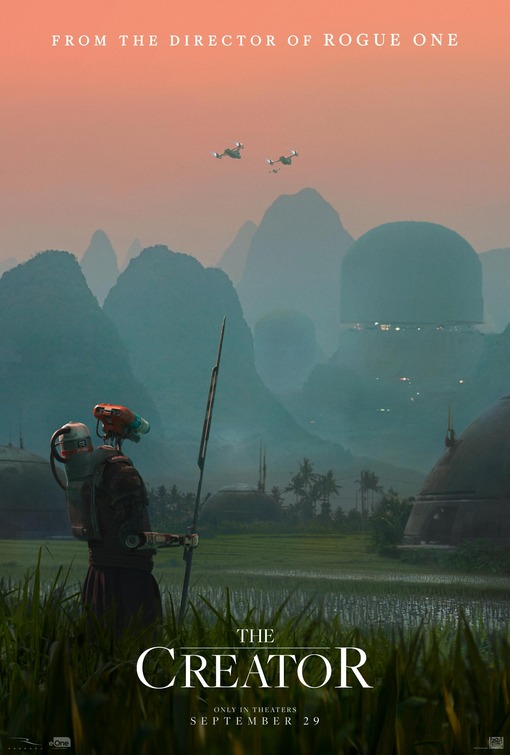

What lands first is the scale of the thing relative to what it cost. Edwards built a future that looks inhabited rather than assembled, because in a lot of cases it was: paddy fields, temples, and refugee-camp architecture standing in for a war zone where AI life has been pushed to the margins. That grounding does more work than the plot mechanics, which are fairly standard hardened-soldier-meets-innocent stuff. The image of a stealth bomber gliding low over rice terraces sells the world faster than any line of dialogue could, and the film leans on that trick again and again, mostly successfully.
John David Washington plays the soldier with a flatness that reads as exhaustion rather than blankness, and it works better opposite Madeleine Yuna Voyles's robot child than it might have opposite an adult co-star — there's an actual tenderness in how careful he is with her, and the film doesn't rush past it. The Vietnam-War imagery stamped onto the AI-refugee allegory is not subtle, and it doesn't need to be; the emotional throughline is simpler and more effective than the politics.
A war movie that spent its budget on dust and light instead of another logo.
Where it stumbles is dialogue that occasionally sounds like a placeholder nobody replaced, and a villain apparatus (the AI-hunting mothership, the chain of command) that's more functional than interesting. None of that undoes the film's central bet, which is that spectacle built from real dust and real light beats spectacle built from nothing. Pick this over another franchise sequel if you want a studio picture that's still trying to imagine something instead of just extending it.
Edwards shot the film almost backwards by studio standards: production began in Thailand in January 2022 with a skeleton crew and no finished script for the technology, and ILM sent a single visual-effects supervisor, Andrew Roberts, to the set rather than the usual large unit. Edwards would photograph locations on his phone and hand the stills to production designer James Clyne and ILM's team, who then designed robots, ships, and cities to match what had already been filmed across sixteen Thai provinces plus stops in Nepal, Cambodia, Indonesia, and elsewhere.
The Creator opened to strong reviews for its visual craft relative to its reported $80 million budget, with much of the trade coverage framing it as a rebuke to VFX-bloated blockbusters costing three or four times as much. It earned two Academy Award nominations, for Best Visual Effects and Best Sound, and grossed around $104 million worldwide — a modest commercial result but enough, combined with the critical reaction, to keep Edwards in the conversation as one of the few directors trusted with large-scale original sci-fi rather than franchise work.