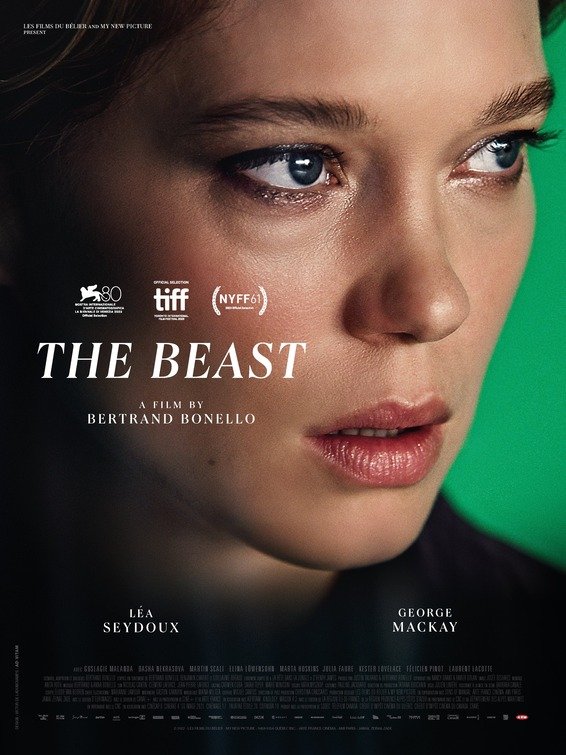
Bonello builds the film like a triptych that refuses to resolve into one picture: a flood melodrama, a home-invasion thriller modeled uncomfortably close to a real 2014 mass shooting, and a hushed, near-empty future where feeling too much has become a liability. Léa Seydoux is the connective tissue, playing the same anxious, hungry-for-connection woman in three registers, and she's the reason the film holds together as long as it does even when the structure keeps interrupting itself.
The 2044 sections are the most interesting on the page — a world where humans hand emotional processing over to algorithms and call it purification — but they're also the most static on screen, long stretches of quiet interiors that ask you to sit with dread rather than watch it escalate. The 1910 flood sequences are the most purely cinematic, and the 2014 material is the one stretch that's flatly difficult to sit through by design, not accident.
A hundred-year love story that keeps circling the same catastrophe, told by a director more interested in dread than in resolution.
This isn't a film built for a clean payoff, and it will lose viewers who want the three timelines to click together like a puzzle. It's closer in spirit to the kind of internationally-minded, idea-first sci-fi that trusts an audience's patience over its comfort — a swing for something stranger than plot, even where the swing doesn't fully connect.
The Beast premiered in competition at the Venice Film Festival on September 3, 2023, before playing Toronto and the New York Film Festival later that year, ahead of a French theatrical release in February 2024. Bonello has said in interviews that he came to regret setting the futuristic segment specifically in 2044, once real-world AI development moved faster than he expected during the years he spent writing and shooting the film. The production was a France-Canada co-production, financed in part through Arte France Cinéma.
Critical response was split but engaged: several major critics called it one of the most ambitious films of the festival circuit that year, while others found its triple-timeline structure exhausting relative to its payoff. It became something of a touchstone in conversations about cinema grappling directly with AI anxiety, arriving in the same stretch as the Hollywood strikes that were partly fought over AI's role in the industry — a coincidence that gave the film's future-set segments an extra charge in the press coverage around its release.
Venice reviews leaned into just how strange the film is willing to get: Deadline's write-up called it "a Lynchian view of the past, present and future," comparing its dream logic directly to Twin Peaks: The Return, while more than one critic singled out Léa Seydoux's performance as a genuine revelation, carrying the film's fear and tenderness across three different eras. The supporting cast also includes Dasha Nekrasova in the 2014-set segment, alongside Guslagie Malanda's presence across the film's timelines. That kind of divisive, genre-blurring reception is fairly typical for Bonello, whose earlier films like Nocturama and Saint Laurent have also split audiences between admiration and impatience — The Beast just does it across a much longer runtime and a much bigger swing.