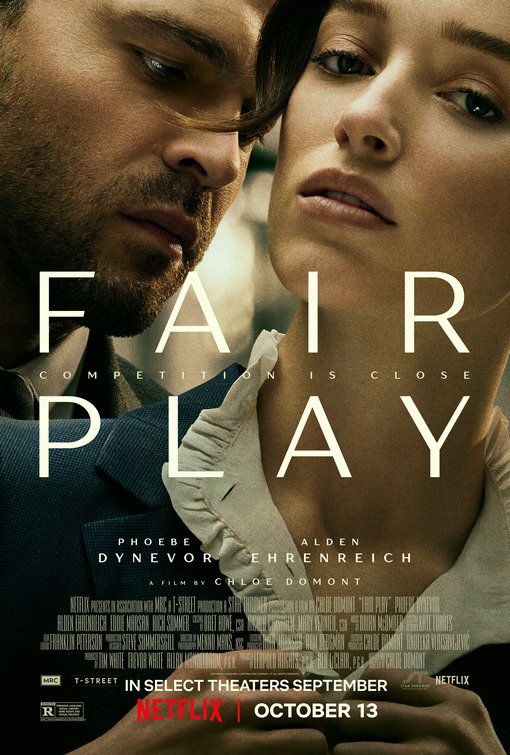

Fair Play opens like a glossy corporate drama and slowly rewires itself into something closer to a horror film, the kind where the monster is a man's ego and the haunted house is a shared studio apartment. Emily and Luke are engaged, sleeping together in secret because their firm bans office romances, and building a life on the assumption that they're equals. Then Emily gets the promotion Luke was told was his. Chloe Domont doesn't stage the fallout as a single explosion — she tracks the slow leak, the passive comments, the way Luke's affection curdles into something colder every time Emily succeeds at work. It's uncomfortable the way a good thriller about intimacy should be, because the tension isn't a stranger with a knife, it's the person who knows you best turning that knowledge into a weapon.
Phoebe Dynevor, mostly known for the corseted romance of Bridgerton, plays Emily with a hardness that sneaks up on you — she starts the film soft-spoken and ends it capable of things that would have seemed impossible in the opening scene. Alden Ehrenreich has the tougher job, since Luke has to stay sympathetic long enough for his resentment to land as tragedy rather than caricature, and he mostly pulls it off, letting wounded pride curdle in real time instead of snapping into villainy on cue. The finance-world setting gives Domont plenty of ammunition — bonus pools, trading-floor machismo, the specific cruelty of open-plan offices — but the film stays interested in the marriage-shaped thing collapsing at its center rather than turning into a Wall Street satire.
Fair Play turns a hedge-fund promotion into the most dangerous thing that's ever happened to this couple's relationship.
Where Fair Play earns its thriller label is the final stretch, which trades slow-burn dread for something more overt and, frankly, more satisfying than most awards-adjacent relationship dramas bother to attempt. Domont builds toward a confrontation that plays like a long-overdue reckoning rather than a shock twist, and she lets Emily's response go further than a tidier movie would allow. It's not a subtle film about workplace gender dynamics, and it doesn't need to be — the imbalance it's diagnosing is blunt in real life too. Anyone who's watched a relationship curdle because one partner's success became the other's insult will find this one uncomfortably familiar.
Domont began writing Fair Play after a string of relationships with men who felt threatened by her professional ambition, and shot the film in New York on a compressed schedule that leaned heavily on rehearsal to keep pace during production. The screenplay drew interest from multiple distributors after its Sundance premiere in January 2023, and Netflix's reported $20 million acquisition made it one of the festival's headline deals that year. Domont has cited workplace-set thrillers and erotic thrillers of the '80s and '90s as touchstones, while insisting the film's sexuality stay tied to power rather than titillation. It marked her feature debut after years directing episodes of Ballers and Suits.
Fair Play received strong reviews on release, with particular praise for Dynevor's performance and Domont's handling of the film's escalating dread. It played a limited theatrical run before streaming on Netflix in October 2023, becoming one of the more talked-about awards-season sleeper titles that year despite receiving no major nominations. Critics frequently compared it to Fatal Attraction and Wall Street while noting it had sharper things to say about gender and ambition than either. The film raised Dynevor's profile beyond Bridgerton and confirmed Domont, previously known mostly for TV work, as a filmmaker worth watching, leading to further feature offers since.