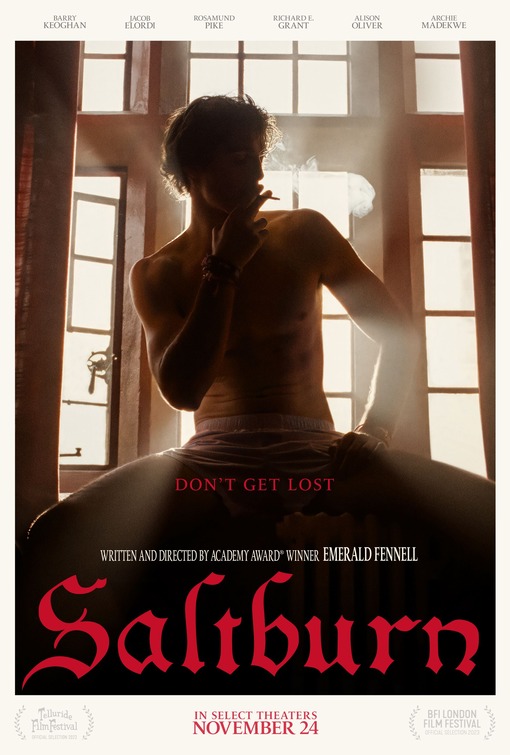

Saltburn works as a seduction before it works as anything else, and Emerald Fennell understands that the surest way to make an audience complicit in something monstrous is to make the outsider's point of view irresistible. Barry Keoghan's Oliver Quick arrives at Oxford as a scholarship student nobody notices, and the film tracks his slow absorption into the orbit of Jacob Elordi's golden-boy Felix with the patience of a predator, not a puppy. Fennell shoots the Catton family's estate — the titular Saltburn — as something closer to a labyrinth than a house, all long corridors and watchful portraits, so that by the time the film reveals how calculated Oliver's ascent has been, the architecture itself feels complicit.
Keoghan carries the whole design on his face, letting Oliver's hunger show through cracks in an otherwise blank, ingratiating mask, and it's a performance built on discomfort rather than charm. Rosamund Pike, as the family's imperious matriarch, gets some of the film's sharpest and funniest lines, treating cruelty as a form of hospitality. Fennell stages the film's most notorious sequences — a bathwater scene, a grave, a final dance through an empty mansion — with the same unbothered confidence, daring the audience to look away and betting, correctly, that most won't. It's a film that trusts its own bad taste.
An outsider's obsession with old money turns a summer invitation into something far stranger.
Fennell has said the character of Oliver first appeared to her as an imaginary friend years before she wrote the script, complete with the unsettling bathtub image that eventually made it into the finished film. Production shot the Oxford scenes across three real colleges — Magdalen, St Hugh's, and Brasenose — while the Catton estate itself is Drayton House in Northamptonshire, a private home that had never before been used as a filming location. Rosamund Pike reportedly lived in the house during the shoot, soaking up its atmosphere for a role built on old-money entitlement. The mix of real aristocratic architecture and invented family drama gives the film a texture few contemporary thrillers bother with.
Saltburn split critics on release, landing around 72% on Rotten Tomatoes against a cooler 61 on Metacritic, with much of the disagreement centered on whether its shock tactics earn their audacity or just chase it. Theatrically it was a modest performer, grossing roughly $21 million worldwide against a $20 million budget, but its real impact came after release, once streaming and a viral closing-dance sequence turned it into one of the most discussed films of the year. Whatever the critical split, Saltburn cemented Fennell as one of the more provocative voices in mainstream drama, following her Oscar-winning debut Promising Young Woman with something even harder to shake.
The now-iconic closing dance sequence did more than cement Saltburn's reputation for going too far — it resurrected a 23-year-old pop song. Sophie Ellis-Bextor's 2001 single "Murder on the Dancefloor," the track Keoghan struts and prances to through Saltburn's empty halls, shot back up to No. 2 on the UK singles chart in early 2024, matching the exact peak it hit on its original release, and debuted on the US Billboard Hot 100 for the first time in the song's history. Ellis-Bextor has said Fennell told her there wasn't really a backup song if she had said no to the usage, calling the sudden second life for the track "magical" and something she still hasn't fully processed. It's a rare case of a film's needle-drop reshaping the pop charts rather than the other way around.