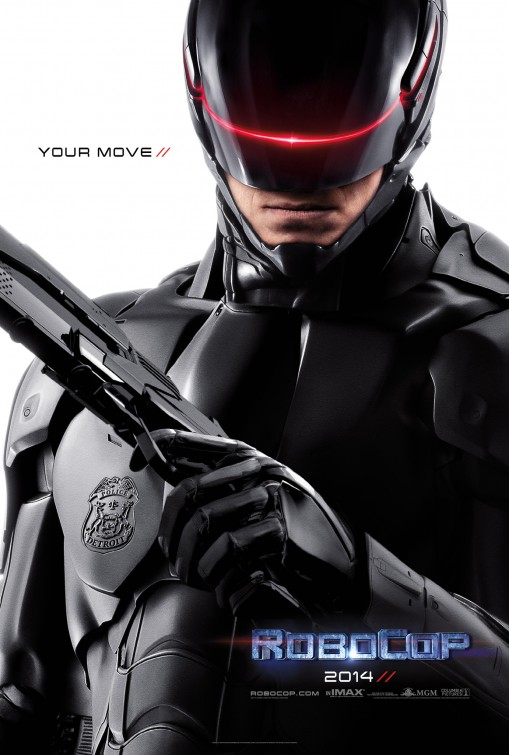
José Padilha's remake keeps the bones of the 1987 original — a critically wounded Detroit cop rebuilt as a corporate-owned cyborg — and updates the target from street crime to drone warfare and the politics of automated policing. Joel Kinnaman plays Alex Murphy with more interiority than the role strictly demands, while Gary Oldman's conflicted scientist and Michael Keaton's coldly pragmatic executive give the corporate half of the story real teeth instead of cardboard villainy.
The 'why remake it' skepticism going in was fair, and the film answers it better than expected by actually having something on its mind rather than just restaging the greatest hits for nostalgia's sake. Samuel L. Jackson's satirical news-show framing device is a blunt but effective way of keeping the original's media-satire streak alive, even as the action itself plays noticeably more restrained and PG-13 than its famously ultraviolent predecessor.
This RoboCop is less interested in who pulls the trigger than in who wrote the software that decides to.
A 3.8 and 66% reflects a remake that earns its own reason to exist instead of simply cashing in on a beloved name. It is more thoughtful than loud, which will disappoint anyone hoping for a beat-for-beat retread of the original's satire and gore — but taken entirely on its own terms, this RoboCop genuinely holds up rather well.
This RoboCop had a long road to the screen: Sony and MGM first floated a remake in the mid-2000s, and the project stalled more than once before Brazilian director José Padilha, known for the gritty crime drama Elite Squad, took the reins. Joel Kinnaman was cast in the title role less for physical resemblance to the original's Peter Weller and more for his ability to convey the emotional toll of surviving a near-fatal attack, with Gary Oldman, Michael Keaton, and Samuel L. Jackson filling out the supporting cast. Made on a substantially larger budget than Paul Verhoeven's 1987 original, the film updates the corporate-satire premise for a modern surveillance-and-drone-warfare era while softening some of the extreme violence to secure a wider PG-13 rating.
Inevitably, the 2014 RoboCop was measured against Verhoeven's original, and most comparisons favored the older film's sharper satirical edge; Verhoeven himself said publicly that he felt the remake lacked that same sense of humor. Still, the new version found its own audience among viewers drawn to its more grounded, character-focused take on Alex Murphy's transformation and its updated commentary on drone warfare and corporate influence over policing. It performed well enough commercially to become the highest-grossing entry in the RoboCop franchise, even if it never displaced the cult reputation of the 1987 film among longtime genre fans.
The suit itself became an unlikely subplot both on and off screen. When early set photos leaked in 2012 showing RoboCop in an all-black, more streamlined design, longtime fans reacted badly, arguing it looked generic next to the original's bulkier chrome-and-black look. The finished film folds that exact controversy into its own plot: OmniCorp executive Raymond Sellars decides mid-movie that Murphy's classic silver-grey armor should be swapped for a sleeker black 'tactical' suit purely as a marketing move, only for RoboCop to return to the familiar grey design by the final battle. It's a rare case of a production visibly answering its own fandom's complaints by writing the complaint into the story. The film ultimately cost around $130 million and grossed over $242 million worldwide, landing at 50% on Rotten Tomatoes, numbers that back up its reputation as a solid commercial performer that split critics down the middle.