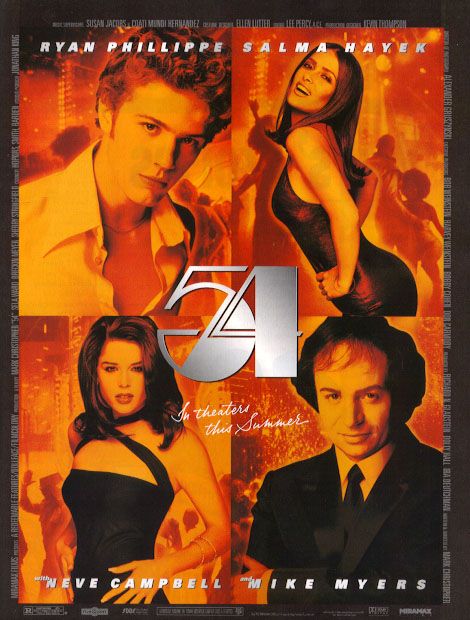
54 works best as a time capsule of the disco excess it's trying to dramatize, even when its plot machinery creaks. Mark Christopher stages Studio 54's dance floor as a genuine sensory overload — strobing light, cocaine dust, half-dressed bodies pressed against velvet ropes — and for stretches the film feels like it's smuggling you inside the club rather than recreating it on a soundstage.
Mike Myers is the reason to watch it. Playing Steve Rubell as a jittery, coke-thin predator with a car-salesman's charm was a hard swerve from the comic persona he'd built on Saturday Night Live and in Wayne's World, and he leans into Rubell's ugliness without begging for sympathy. Ryan Phillippe is mostly required to look good under lighting, but Salma Hayek gives her aspiring-singer subplot more ache than the script around her earns.
A disco fever dream sabotaged by its own studio, and salvaged decades later by its director.
The theatrical cut audiences saw in 1998 was not the movie Christopher shot. It took him roughly five years of research into the real Studio 54 to write the script, and Miramax responded to poor test screenings by ordering extensive reshoots and trimming more than 40 minutes of his original footage, softening a bisexual subplot involving Phillippe's character in the process. Christopher spent years trying to get his version seen; in 2015, working from dailies he'd personally tracked down, he and a newly cooperative Miramax released '54: The Director's Cut,' restoring around 45 minutes of unseen material and cutting roughly 30 minutes of the studio's reshoots.
Critics were unkind to the theatrical cut on release — it landed around 15% on Rotten Tomatoes and a 33 Metascore — and the film only narrowly cleared its budget, grossing about $16.8 million worldwide against a reported $13 million cost. The Director's Cut hasn't erased that history, but it has meaningfully changed the conversation, with critics calling it a considerable step toward the darker, queerer movie Christopher always intended. Watched today, especially in its restored form, 54 plays less like a misfire and more like a cautionary tale about what a studio's nerves can do to a filmmaker's original vision.
The 2015 release wasn't even Christopher's first attempt to get his version in front of an audience. Nearly a decade earlier, in 2008, he quietly assembled a bootleg cut from whatever surviving footage he could gather and screened it unofficially at New York's Outfest, long before Miramax agreed to a sanctioned restoration. Ryan Phillippe, for his part, was never shy about how he felt regarding the theatrical cut, saying openly that he disliked how thoroughly the studio had stripped the film of its sexual candor and drug content — including gutting a core love triangle between his character, Salma Hayek's, and Breckin Meyer's that Christopher had built much of the drama around. Seen against that history, the eventual director's cut plays less like a nice bonus feature and more like the film finally catching up to what its own star had been saying about it for years.