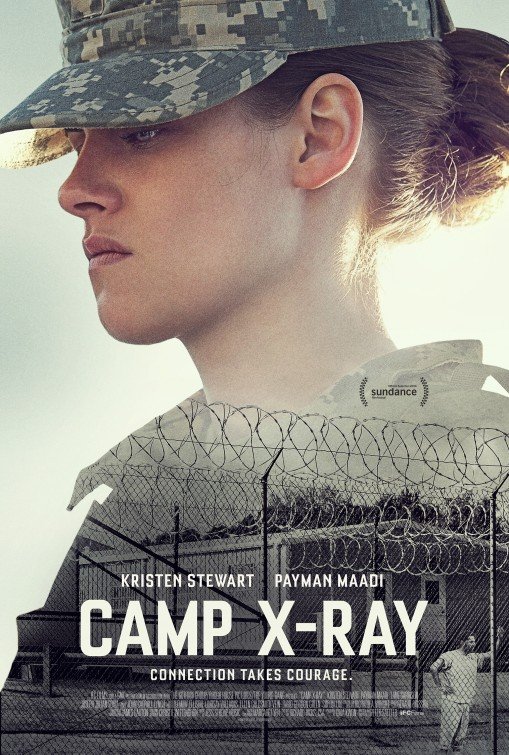

Kristen Stewart plays a green Army private assigned to guard duty at Guantanamo Bay, stuck walking the same block of cells for months on end, and Payman Maadi plays a long-held detainee who's figured out how to needle and befriend his guards in equal measure. Peter Sattler builds the whole film out of that dynamic, small talk through a food slot, boredom, routine, and the occasional flash of real cruelty from the system around them.
It's a deliberately unglamorous movie, no rescue plot, no big political speech, just two people circling each other across a barrier neither of them chose. Stewart plays the private's disillusionment as something that creeps in slowly rather than arriving in one big moment, which is a harder note to hit than it sounds. The film trusts long silences and repetition to do the work most dramas would rush through.
Nobody here gets a speech, they just get each other, slowly.
That patience is the whole point, and also why it won't be for everyone, it's a movie about institutional numbness that occasionally makes you feel a little numb yourself. But the connection at its center is genuinely affecting once it's earned, and a 3.9 with a 69% feels like fair credit for a film that's uncomfortable by design and mostly pulls it off.
Camp X-Ray marked a deliberate turn for Kristen Stewart, arriving shortly after the Twilight franchise ended and signaling her shift toward smaller, more challenging independent films. Writer-director Peter Sattler built the story almost entirely around an extended, evolving conversation between a guard and a detainee, using the claustrophobic setting to explore isolation, authority, and reluctant empathy rather than staging a conventional political thriller. The film was shot on a modest budget at a former prison facility standing in for Guantanamo, and it debuted to a mixed but respectful critical response at Sundance, with much of the praise directed at Stewart's understated performance and her co-star Peyman Moaadi.
Rather than taking an overtly political stance on Guantanamo Bay itself, Camp X-Ray is more interested in the human relationship that forms inside an inherently inhumane system, which is part of why it has aged into something of a low-key sleeper for fans of quiet, dialogue-driven drama. It's a good pick for viewers who appreciated Stewart's more introspective post-Twilight work, and for anyone drawn to two-hander films where nearly the entire emotional weight rests on a handful of extended scenes between two characters who are technically on opposite sides.
Payman Maadi came to the project already an internationally recognized dramatic actor, having starred a few years earlier in Asghar Farhadi's A Separation, the Iranian drama that won the Academy Award for Best Foreign Language Film in 2012, a credential that goes a long way toward explaining the weight he brings to scenes that could otherwise feel like a two-hander acting exercise. Stewart, for her part, hadn't taken a film role in nearly two years when she signed on, and she committed to the physical unpleasantness of Amy Cole's job without visible vanity, the role has her taking an elbow to the face, getting spat on, and getting doused with a bucket of thrown feces, all played completely straight rather than for shock value.