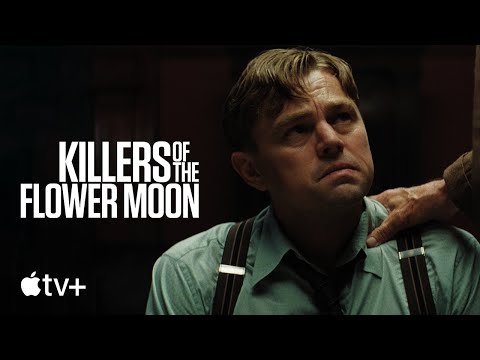
Killers of the Flower Moon could have been a detective story — the historical record even offers one, since the murders were eventually investigated by the fledgling FBI — but Scorsese restructures the film to follow the killers instead, and that choice is what makes it so unsettling. We're never asked to wonder whodunit; we watch Ernest Burkhart do it, in close-up, while telling himself he loves his wife. Leonardo DiCaprio plays him not as a mastermind but as a man too weak and too greedy to refuse his uncle's instructions, which is a much harder, less flattering performance than the charismatic-villain version another film might have cast him in.
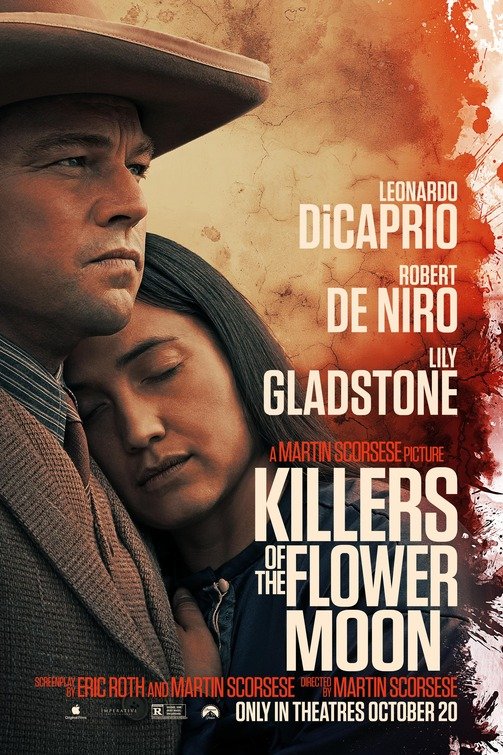
Lily Gladstone's Mollie is the film's moral center and its quietest performance — she says less than almost anyone else in a three-and-a-half-hour movie, and somehow carries more weight than DiCaprio or De Niro's scenery. Robert De Niro, as the outwardly folksy, secretly murderous William Hale, gives one of his most controlled performances in decades, all soft-spoken menace and civic-minded smiles. Scorsese doesn't shoot this with the kinetic energy of Goodfellas or Casino; the camera holds still and lets the horror of complicity sit in the frame rather than cutting away from it.
A murder story told entirely from inside the murderers' heads.
Scorsese brought Osage Nation members onto the production at every level — costume design, language coaching, and Chief Standing Bear himself as a consultant — and their involvement reportedly reshaped the film substantially from its original, more FBI-centric script. Osage orthography opens the film, and Christopher Côté coached the cast in the Osage language so it could be spoken accurately on screen. At a reported $200 million budget, it's among the most expensive biographical dramas ever made, funded by Apple Original Films specifically to give Scorsese the scale and runtime a more traditional studio wouldn't have greenlit.
Critics were overwhelmingly positive — 93% on Rotten Tomatoes and 89 on Metacritic — and the film picked up ten Oscar nominations, including Best Picture, Best Director, and acting nods for DiCaprio, De Niro, and Gladstone. It wasn't a conventional box-office hit given its length and subject matter, but Apple treated it as a prestige investment rather than a blockbuster bet, and it's since become one of the most studied entries in Scorsese's late career — a film more interested in reckoning with American guilt than delivering a crime-thriller payoff.
The script, co-written by Scorsese and Eric Roth, is adapted from David Grann's 2017 nonfiction bestseller of the same name, which reconstructed the Osage murders and the FBI's early investigation from archival record. Scorsese and Roth reportedly reworked their own draft late in development to shift the story's center of gravity away from the federal agents and toward Mollie and Ernest's marriage, which is why the finished film reads less like a procedural than the book did. That instinct paid off at Cannes, where the premiere drew a nine-minute standing ovation, with the loudest response reserved for Gladstone, who went on to become the first Native American performer to win a Golden Globe for Best Actress and opened her acceptance speech partly in Blackfeet.