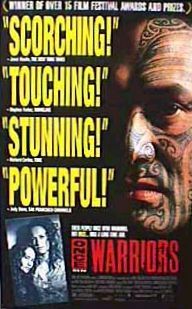
Beth and Jake Heke are raising their kids in urban Auckland, cut off from the Māori land and community their ancestors knew, and Lee Tamahori doesn't soften a single inch of what that displacement does inside their house. Temuera Morrison plays Jake's charisma and his violence as the same coin flipped over and over, and Rena Owen matches him with a performance that carries the entire film's conscience on her shoulders.
This isn't generational trauma as a tidy metaphor, it's specific, brutal, and shot with total conviction, a party scene that curdles into horror, a teenage son pulled toward gang life, a daughter quietly disappearing into herself. Cliff Curtis and the rest of the ensemble fill out a family that feels lived-in rather than assembled for a message. It's bleak, but never in a way that feels exploitative rather than earned.
Charisma and violence, same coin, flipped over and over.
It became essential New Zealand cinema for a reason, a film that took its own culture's pain seriously instead of flattening it for outsiders. A 4.5 and an 82% reflect a movie that's genuinely hard to watch and even harder to shake afterward, one of those rare dramas whose reputation as devastating undersells just how good it actually is.
Once Were Warriors was adapted from Alan Duff's controversial 1990 novel and directed by Lee Tamahori in his feature debut, working from a screenplay by Riwia Brown. Made by the newly formed Communicado Productions, it arrived with a level of raw social realism that New Zealand cinema hadn't shown at this scale before, tackling domestic violence, urban poverty, and the erosion of Maori identity head-on rather than softening them for a wider audience. The film was a genuine cultural phenomenon on release, becoming the highest-grossing New Zealand film of its era and sparking widespread public conversation in the country about family violence.
The performances from Rena Owen and Temuera Morrison, in particular, are still frequently cited as among the most powerful in New Zealand film history, and the movie helped launch both Morrison and director Lee Tamahori into international careers. Decades on, Once Were Warriors remains a benchmark of New Zealand cinema and is often discussed alongside The Piano as one of the two films that put the country's film industry on the international map. It's an intense, unflinching watch best suited to viewers looking for social realism rather than an easy or comforting drama.
The film's unflinching portrayal of violence within a Maori family wasn't without controversy at home, both Alan Duff's novel and Tamahori's adaptation drew criticism on release from some who felt the material risked reinforcing stereotypes rather than confronting them, a debate that has followed the story through every subsequent adaptation. A sequel, What Becomes of the Broken Hearted?, followed in 1999, based on Duff's 1996 novel of the same name and continuing Beth and Jake's story with much of the same cast, though it never matched the original's cultural impact. Once Were Warriors has since received a full 2K digital restoration, making sure a film this important to New Zealand cinema doesn't fade the way so many national breakthrough features eventually do.