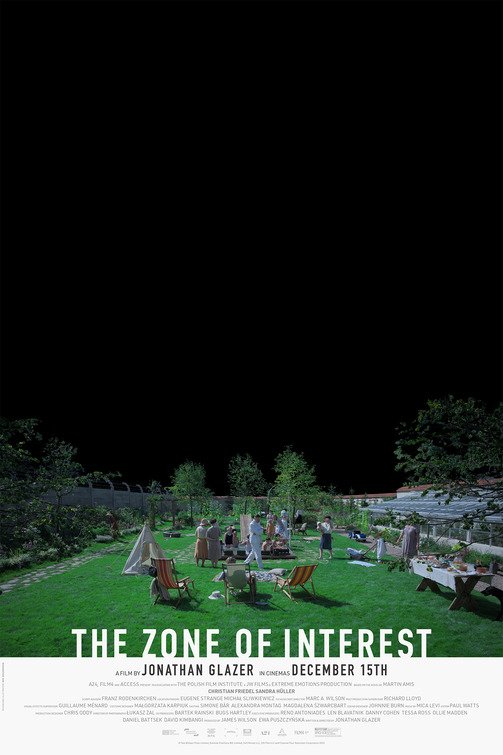

The choice to keep the camp entirely off-screen is the whole argument of the film, and it's a deeply unnerving one to sit inside for an hour and forty-five minutes: gunshots, screams, and the low industrial hum of machinery sit underneath scenes of a family having breakfast, and nobody in the frame reacts to any of it. Glazer isn't asking you to imagine the horror so much as forcing you to notice how completely it's been tuned out by the people living beside it.
Sandra Hüller plays the commandant's wife with a chilling flatness — proud of her garden, annoyed by houseguests, entirely unbothered by what's audible from her flowerbeds — and Christian Friedel matches her as a man for whom the camp is simply a logistics problem to be optimized. There's no villain monologue, no moment of reckoning; the film's horror is precisely that these people don't need one.
The most disturbing thing in the movie is what the family next door has simply stopped hearing.
It's not a film that offers catharsis, and it isn't trying to. What it offers instead is a study of how atrocity gets absorbed into the texture of daily life once enough people decide not to look at it, which makes it a harder watch than films that show the violence directly. This is craft in service of an argument, not entertainment, and it earns the difficulty it demands.
Jonathan Glazer shot the film in and around Oświęcim, Poland, near the site of the real Auschwitz-Birkenau camp, using a house built to resemble commandant Rudolf Höss's actual residence. He filmed many scenes with a network of hidden, remotely triggered cameras rather than a traditional crew presence, letting Hüller and Friedel play out extended domestic scenes with minimal interruption. Sound designer Johnnie Burn spent roughly a year building an archive of period-accurate camp sounds — machinery, distant gunfire, muffled screams — that plays under nearly the entire film without ever being addressed on screen.
The Zone of Interest won the Academy Award for Best International Feature Film and, more surprisingly to some observers, Best Sound, beating out the year's presumed sound favorite, Oppenheimer. It holds a 92% "Certified Fresh" rating on Rotten Tomatoes and was widely cited by critics as one of the most formally audacious Holocaust films made, precisely because of its refusal to depict the camp directly. It has since become a frequent reference point in discussions of sound design's capacity to carry a film's entire moral argument.