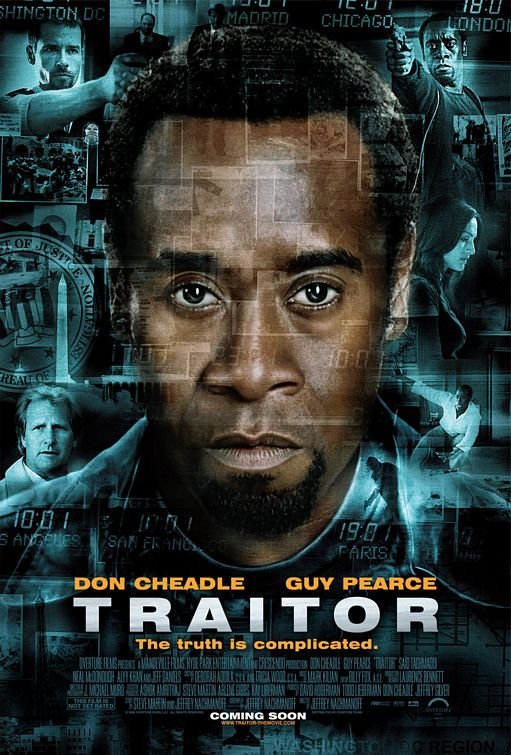
Don Cheadle plays Samir Horn, a devout Muslim and former U.S. special-forces demolitions expert who resurfaces selling explosives to jihadist networks, while Guy Pearce's FBI agent tries to work out whether Samir has genuinely turned or is playing a far longer game. Writer-director Jeffrey Nachmanoff, working from a story credited to Steve Martin, treats the premise with more seriousness than the marketing let on.
Cheadle carries the film on an internal performance — a man reciting prayers between planning attacks he's trying to prevent, holding a faith that the plot never treats as a costume or a twist. The tension comes less from shootouts than from watching Samir manage an impossible position, where every ally could be the one who gets him killed and every choice implicates someone innocent.
The bravest thing about it is refusing to make faith the villain.
Traitor is a smarter and more morally serious spy thriller than its trailer sold, more interested in the psychology of deep-cover work and religious conviction than in set pieces and gunfights. It doesn't reinvent the genre, but it treats its subject and its lead character with real respect, and Cheadle makes the most of a role built almost entirely on internal conflict.
Traitor grew out of an unlikely source: an idea from Steve Martin, who is credited with the original story, which writer-director Jeffrey Nachmanoff then shaped into a full screenplay about an undercover operative caught between his faith and his mission. Don Cheadle stars as Samir Horn, with Guy Pearce as the FBI agent pursuing him, and the production shot on location across Morocco, Canada, the UK, and France to give the globe-hopping plot a grounded, international feel. Originally developed at Walt Disney Pictures, the film ended up as the launch release for the newly formed Overture Films in 2008, arriving in the post-9/11 wave of politically minded thrillers wrestling with terrorism and divided loyalties.
Critics responded warmly to Don Cheadle's controlled, internal performance as a man performing a dangerous double life, even as some found the plot mechanics familiar. Roger Ebert was among the reviewers who praised the film for moving briskly and taking its subject seriously rather than playing it purely for action beats. It never became a major awards contender or a box-office blockbuster, but it turned a modest profit on its budget and has held up as a solid, thoughtful entry in the genre, appealing most to viewers who prefer character-driven, morally tangled spy thrillers grounded in real-world anxieties over louder, more explosive action alternatives.
Traitor holds a specific number worth noting: 64% on Rotten Tomatoes, a modest critical majority in line with its reputation as a solid, unspectacular genre entry rather than a hidden classic. It grossed around $27 million worldwide against a reported $22 million budget, enough to turn a small profit but nowhere near a hit. Nachmanoff reportedly consulted with mosques and Muslim community members during development and cast Muslim actors in several supporting roles to get the religious material right, an unusually deliberate effort for a mainstream American thriller of this era. Reception to that effort was mixed rather than unanimous; some commentators appreciated the attempt at nuance while others felt the finished film still leaned on clumsy shorthand in places. It's a reminder that good intentions and a competent thriller don't automatically add up to a definitive statement on faith and terrorism.