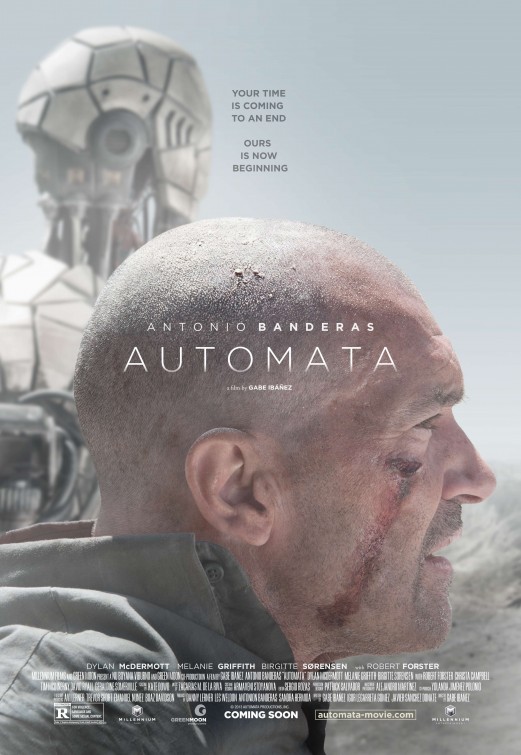

In a near-future where climate collapse has driven most of humanity into a handful of shrinking cities, an insurance investigator played by Antonio Banderas starts looking into reports of robots quietly repairing themselves — a direct violation of the two hard-coded protocols meant to keep them obedient and incapable of self-replication. Director Gabe Ibáñez uses that mystery to ease into much bigger questions about autonomy and what happens once a created thing starts making its own choices.
This is a slow burn by design, far more interested in atmosphere and ideas than the robots-run-amok marketing around it ever suggested, and it earns its Blade Runner comparisons honestly rather than chasing them cynically for attention. Birgitte Hjort Sørensen and Dylan McDermott support Banderas well throughout, and Melanie Griffith's brief, unsettling turn as a technician with a personal stake in the robots adds a genuinely strange note to the film's back half.
The scariest thing here isn't a robot uprising — it's a machine that starts thinking for itself and doesn't ask permission.
A 3.8 and 65% fits a film that trades spectacle for mood and mostly succeeds on that trade — this rewards patience far more than it rewards whatever expectations the poster set for you walking in. If contemplative, idea-driven science fiction appeals to you more than an action ride does, Automata delivers considerably more than its quiet reputation would suggest.
Automata came together through a personal connection: actress Elena Anaya, who had worked with Spanish director Gabe Ibáñez, passed the script to Antonio Banderas while the two were filming Pedro Almodóvar's The Skin I Live In, and Banderas was drawn enough to the material to sign on as both star and producer. The production shot largely in Bulgaria, making use of Nu Boyana Film Studios' facilities and surrounding landscapes to create its sun-scorched, decaying vision of the future on a comparatively modest budget for a science-fiction film. Melanie Griffith, Banderas's wife at the time, joined the cast as well, marking one of several films the couple appeared in together over the years.
Visually, Automata drew frequent comparisons to Blade Runner for its rain-soaked, neon-lit atmosphere and its melancholy tone toward artificial life, even as critics were split on how well its ideas were executed. It found a more receptive audience among science-fiction fans specifically interested in robot-consciousness stories, who appreciated its slower, more contemplative pace compared to bigger-budget robot action films of the same era. For viewers who prefer their sci-fi moody and philosophical rather than explosion-driven, and who enjoy Banderas in a more subdued, world-weary register, it has become something of a quiet recommendation within genre circles.
The film's two robotic protocols are a deliberate riff on Isaac Asimov's famous Three Laws of Robotics — a law against harming life and a law against self-modification — and dropping Asimov's third law, the one protecting a robot's own survival, is the whole plot in miniature: these machines were built with no legal right to protect or improve themselves, which is exactly the rule they eventually start breaking. Despite the ambitious ideas and Banderas's noir-inflected lead performance, critics were largely unconvinced on release, with Automata settling at just 31% on Rotten Tomatoes. It fared somewhat better on the awards circuit at home, picking up four nominations at Spain's Goya Awards, including one for its cinematography, recognition for the atmospheric, sunburned visual style that even skeptical reviewers tended to single out as the film's strongest asset.