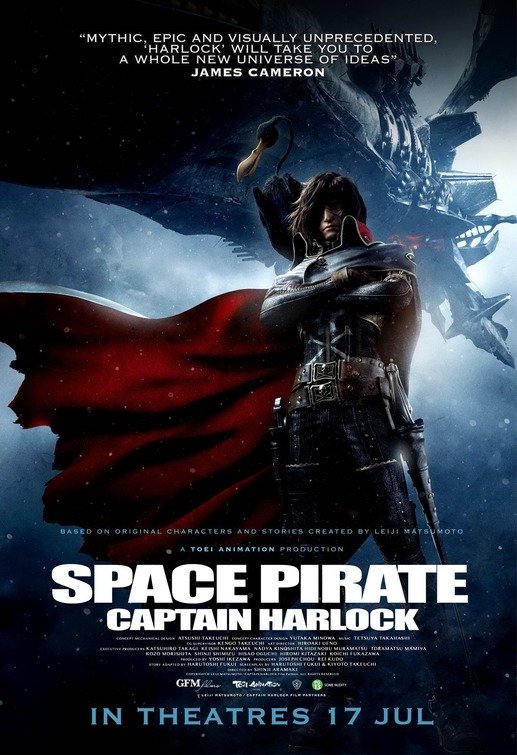
Space Pirate Captain Harlock earns its spot on any sci-fi watchlist for one reason above all: it looks like nothing else from its era. Shinji Aramaki and his team poured a staggering budget into photorealistic CG animation, and it shows in every scene — starships that feel genuinely massive, space battles with real weight and scale, and a lived-in retro-futurist design language pulled straight from Leiji Matsumoto's original manga. This isn't anime rendered to look like a cartoon; it's built to feel like a big-budget space opera, and the craftsmanship holds up remarkably well for a mid-2010s production.
Where the film wobbles is in pacing and tone. The story leans heavily into portentous dialogue and cosmic-scale stakes, and it takes itself extremely seriously — sometimes to a fault. Newcomers unfamiliar with the decades-old Harlock mythology may find themselves catching up on lore mid-scene rather than settling into the plot. But stick with it and the film rewards patience: the central conflict between duty and rebellion gives the visuals real emotional ballast, and the back half builds to genuinely tense, well-staged set pieces that justify the slower build-up.
A CG space opera so visually ambitious it's worth watching for the spectacle alone.
This is a recommendation for a specific kind of viewer: anyone who grew up loving space opera spectacle, or anyone curious what a AAA-budget anime blockbuster looks like when a studio swings for the fences visually. It's not the easiest entry point into anime for newcomers, and it won't convert action fans hoping for constant momentum. But as a visual experience — and as a tribute to one of anime's most enduring antihero characters — it's a bold, sincere piece of work that's worth seeking out on a big screen or the best TV you've got.
Space Pirate Captain Harlock adapts Leiji Matsumoto's Captain Harlock manga and anime franchise, which dates back to the 1970s and has spawned numerous TV series, films, and spin-offs across five decades. This 2013 version was a full CG reboot, produced by Toei Animation and Marza Animation Planet at a reported cost of around ¥3 billion, making it one of the most expensive Japanese animated films ever produced at the time. The production aimed to modernize Harlock for a new generation using photorealistic 3D character animation rather than traditional cel-style art, a technical gamble that paid off visually even as the film struggled to recoup its budget at the worldwide box office.
Harlock has been reinterpreted many times since Matsumoto created him, but this CG version stands apart as the character's biggest technical swing — closer in spirit to a Hollywood sci-fi tentpole than a typical anime release. It never became the crossover hit its budget suggested it was aiming for, but it has found a steadier life among genre fans who prize visual ambition over polish, and among longtime Harlock devotees curious how the character translates to modern animation technology. If you've ever wished an anime looked and moved like a big-budget space epic, this is one of the clearest examples the medium has produced.