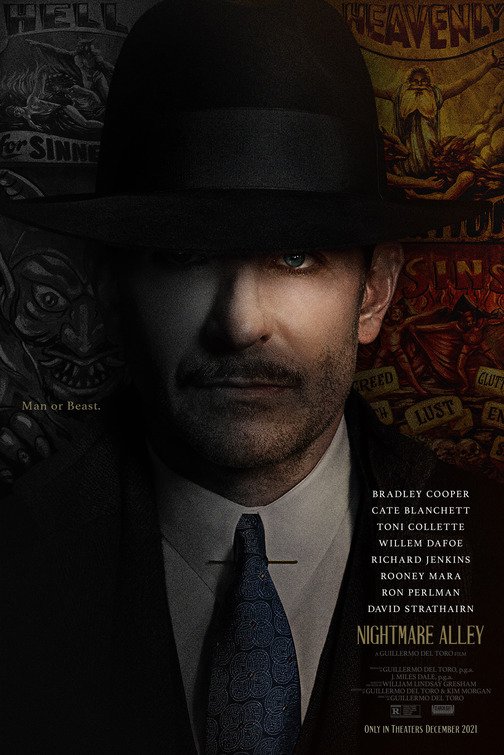

Guillermo del Toro doesn't often work in pure noir, and Nightmare Alley shows exactly why more directors should let him try — this is one of the most gorgeously designed films of the 2020s, a world of carnival grime and Art Deco excess rendered in the kind of tactile, handmade detail that's become rare in studio filmmaking. Bradley Cooper plays against type as a hollow, ambitious con man, and Cate Blanchett is genuinely chilling as the psychiatrist who sees through him before we do. It's a patient, novelistic film that asks you to sit with its atmosphere rather than rushing you toward payoff, and it's richer for it.
This is a slow burn in the best sense — a two-and-a-half-hour descent that trusts its own moral architecture, building Stan Carlisle's rise and fall with the inevitability of a fable rather than a twist-driven thriller. The supporting cast is stacked with people clearly relishing the material, from Willem Dafoe's carnival barker to Toni Collette's world-weary seer, and every one of them earns their scene. It demands patience some viewers won't have, and its unhurried pace was a real sticking point for a portion of critics and audiences on release, but if you let it work at its own speed, the craft on display is close to unimpeachable.
A gorgeous, patient noir that trusts you to sit in the dark with it.
Recommended if you want a noir that looks and feels like a haunted-house fable, and if you have the patience for a filmmaker in complete, unhurried control of his craft. It earned four Oscar nominations including Best Picture, which tells you the industry recognized the achievement even if it didn't find a big audience in theaters — an underperformance more about pandemic-era release timing than the film's quality. Watch the color version first for Dan Laustsen's cinematography, then consider the black-and-white re-edit del Toro released afterward; both make the case for a film that rewards a second look more than almost anything else released that year.
This is the second feature adaptation of William Lindsay Gresham's 1946 novel Nightmare Alley, following the 1947 version starring Tyrone Power; del Toro has described his film as a standalone take rather than a remake, drawing out darker elements of the source novel. Leonardo DiCaprio was briefly in negotiations for the lead before Bradley Cooper was cast in 2019. Principal photography began in Toronto in January 2020 and was suspended after roughly 45 percent of the shoot was complete when the COVID-19 pandemic halted production; filming resumed that September and wrapped in December, an unplanned six-month gap that the filmmakers ultimately used to refine the film.
Reception leaned strongly positive, with particular praise for the production design, Dan Laustsen's cinematography, and the ensemble cast, even as some reviews flagged the nearly two-and-a-half-hour runtime as a lot to sustain. The film received four Academy Award nominations, including Best Picture, Best Cinematography, Best Production Design, and Best Costume Design. Commercially it struggled, grossing under $40 million worldwide against a $60 million budget, a shortfall widely attributed to pandemic-era theatrical caution among older audiences rather than the film's critical standing. A black-and-white theatrical cut, billed as del Toro's original vision for the film's texture, expanded to over a thousand US theaters in early 2022.