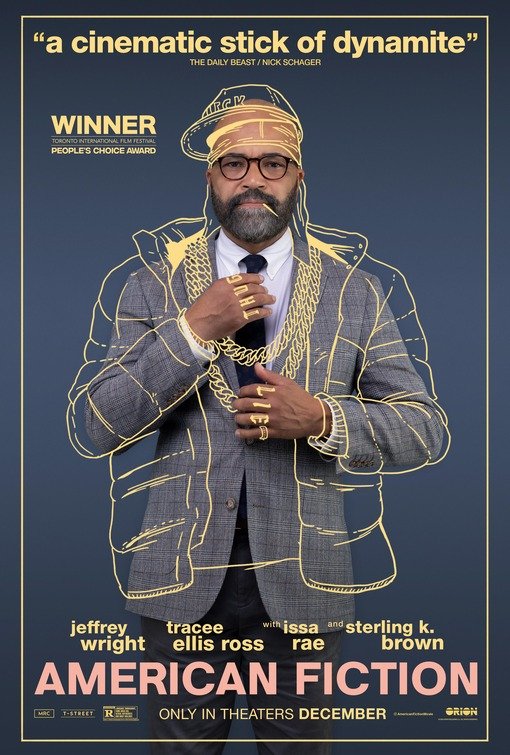

American Fiction sets up a satire and then, midway through, refuses to stay inside it — Cord Jefferson keeps cutting away from Monk's ridiculous fake bestseller to his actual, unglamorous family life: a mother sliding into dementia, a brother in freefall, a sister he barely knew before her sudden death. That structural choice is the film's smartest move, because it lets the satire land harder by surrounding it with something achingly sincere. Monk's contempt for the publishing industry's appetite for Black trauma isn't just a punchline; it's a man watching an industry profit from a version of his life he doesn't recognize, while his real life quietly falls apart around him.
Jeffrey Wright plays Monk with a controlled, exhausted irritation that never tips into shtick, which is exactly why the character's hypocrisies land — he's disgusted by pandering fiction and still can't resist cashing the check. Sterling K. Brown, as Monk's newly out, newly reckless brother Cliff, steals scenes by refusing to play grief the way the family expects him to. Tracee Ellis Ross and Erika Alexander both do quieter work as the women holding the family together while Monk performs his rebellion, and the film is smart enough to notice the imbalance in who does the actual emotional labor.
A satire so accurate it stopped being funny halfway through.
Jefferson adapted the film from Percival Everett's 2001 novel Erasure, a book that had circulated in Hollywood for years as unfilmable satire before Jefferson — an Emmy-winning television writer making his feature directorial debut — convinced Everett to trust him with it. Everett had reportedly been wary of adaptations of his more difficult work, which makes the resulting film's fidelity to the novel's anger and its ambivalent ending notable rather than watered down. Jefferson wrote and directed the film for a lean $10 million budget, keeping the production small enough to protect its tonal risks from studio interference.
American Fiction scored 93% on Rotten Tomatoes and 81 on Metacritic, and it punched well above its modest $23 million box office in awards recognition, earning five Oscar nominations including Best Picture and a Best Actor nod for Wright, with Jefferson winning Best Adapted Screenplay. It's become a reference point in conversations about the publishing industry's relationship to Black authors specifically because it doesn't offer easy villains — everyone in the system, including Monk, is compromised by it, a harder and more honest note to end on than a clean takedown would have been.
American Fiction's route to awards attention actually started before Oscar night: it won the People's Choice Award at the Toronto International Film Festival, the same audience prize that has become one of the more reliable Best Picture predictors of the last two decades. Laura Karpman's score threads a warm, almost old-fashioned romanticism through Monk's unraveling life, refusing to let the film curdle into pure cynicism even at its angriest. Everett himself hasn't slowed down since handing Jefferson the rights: his 2024 novel James, a reimagining of Huckleberry Finn told from Jim's perspective, went on to win the National Book Award and the Pulitzer Prize for Fiction, cementing him as one of the most significant American novelists working today, satire or otherwise.