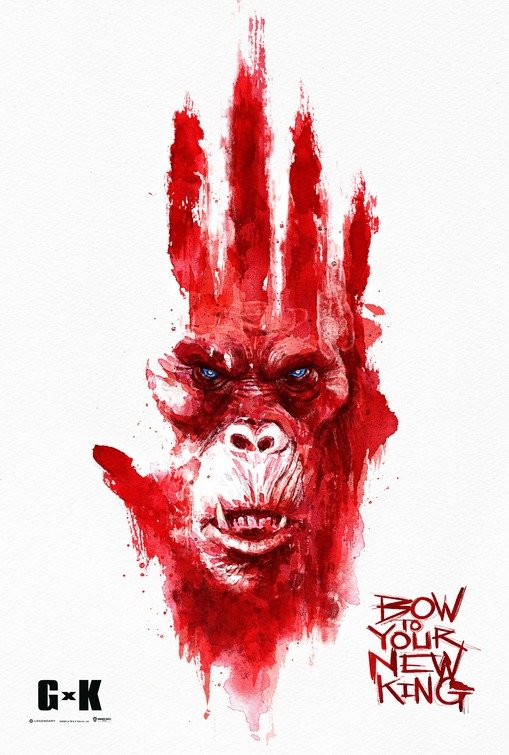
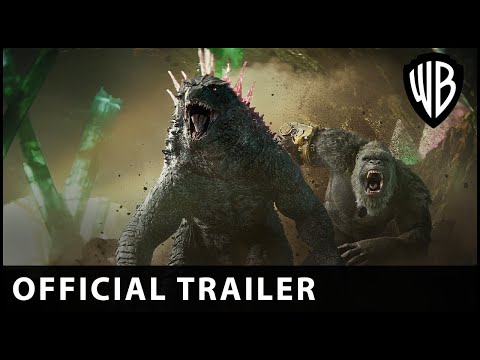
Adam Wingard's sequel drops most pretense of character drama and commits to spectacle as the entire pitch — Godzilla and Kong, once rivals, team up against Skar King, a chained-up ape tyrant who commands a frozen Godzilla-adjacent horror called Shimo. That's a lot of proper nouns for one two-hour movie, and the plot mostly exists to get from one kaiju brawl to the next, but The New Empire also expands Hollow Earth into something closer to a fully realized pulp-adventure setting rather than a plot device. It knows its audience wants monsters, colors, and scale, and doesn't waste much time getting there.
The Skar King himself is the film's best addition — Wētā FX gave him deliberately asymmetrical eyes and a limping, calculating physicality closer to an underworld boss than a beast, and his climactic weapon fight with Kong is staged as a direct homage to the chain duel between Lee Marvin and Ernest Borgnine in Emperor of the North. Rebecca Hall and Brian Tyree Henry return mostly to keep the human half of the MonsterVerse ticking over, but the film is honest about where its real interest lies: with the creature-design team finding new, specific personalities for monsters that could easily have been interchangeable.
Two titans, one chained tyrant, and a Colosseum nap scene stolen from a house cat.
Adam Wingard reportedly based some of Godzilla's more relaxed body language — including a scene of him curled up asleep inside the Colosseum — on the mannerisms of his own cat, a detail that fits a movie more interested in giving its monsters personality quirks than mythology. The production also came in as the cheapest MonsterVerse entry to date, a byproduct of the crew having learned from the more scattershot shooting process on Godzilla vs. Kong. Even Suko, the miniature Kong analog introduced here, got a name with an intentional meaning, translating phonetically from Japanese to roughly "essential child."
Critics were unmoved — Rotten Tomatoes landed in the mid-50s and Metacritic in the high-40s, the weakest reviews of the modern MonsterVerse — but audiences disagreed hard, pushing the popcornmeter score into the high 80s and helping the film gross well over $500 million worldwide. That split is the whole story of this franchise at this point: nobody's mistaking it for prestige filmmaking, but as an exercise in giant-monster choreography and world-building for its own sake, it hits the specific, narrow target it was built for, and hits it with real style.
Filming took place largely on Australia's Gold Coast, with the beachside suburb of Surfers Paradise standing in, rather improbably, for Rio de Janeiro during the film's globe-hopping opening act. The New Empire also introduced Dan Stevens as Trapper, a wisecracking monster veterinarian who supplies most of the film's human comic relief, alongside newcomers Fala Chen, Alex Ferns, and Rachel House rounding out a cast that mostly exists to react to whatever the kaiju are doing next. Even the film's signature new gadget had a mercenary streak — Wingard has said the B.E.A.S.T. Glove, the armored exosuit Kong wears for the climactic fight, was designed partly with an eye toward selling more Kong action figures, an unusually candid admission of how toy-line considerations shape modern blockbuster design.