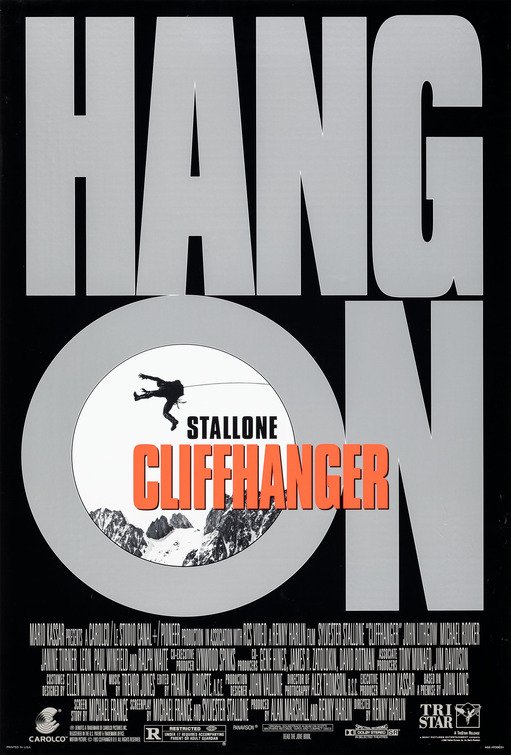
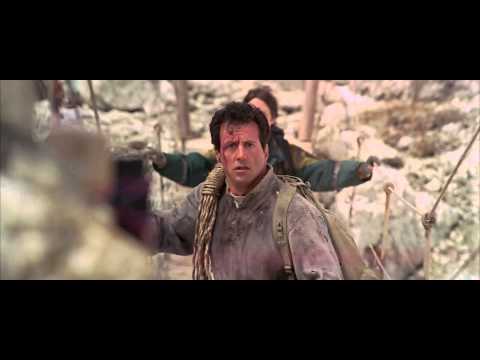
Gabe Walker is a mountain rescue climber still shaken by a fall he couldn't stop, and the last thing he wants is to go back up into the Rockies. He doesn't get a choice — a heist gone wrong scatters a fortune in stolen cash across the peaks, and the people who lost it are willing to kill for it. Stallone spends most of the runtime freezing, bleeding, and climbing anyway.
John Lithgow makes a gleefully nasty villain, cold and precise in a way that plays well against Stallone's grunt-and-survive physicality, and Renny Harlin shoots the mountains themselves like a genuine threat instead of just scenery. The stunt work holds up because so much of it looks and feels real, which is exactly what a movie built on vertigo and freefall needs to sell the danger.
Cliffhanger turns a mountain range into one long, brutal obstacle course and never once lets you catch your breath.
It's a lean, mean survival thriller that never forgets it's also an action movie, stacking one impossible set piece on another without losing the thread of Gabe's guilt. Three decades on, it still holds up better than most of its era's action pictures. Stallone at altitude, doing exactly what he does best, is reason enough to watch it.
Cliffhanger was shot largely in the Italian Dolomites near Cortina d'Ampezzo, with additional location work in Colorado, after director Renny Harlin decided the American Rockies didn't offer the jagged, dramatic peaks he wanted on screen. The production was famously turbulent: the budget ballooned tens of millions of dollars past its original estimate, and financier Carolco Pictures ran into cash-flow trouble severe enough to briefly halt the shoot, with Sylvester Stallone reportedly deferring part of his salary to help keep things moving. Despite the chaos, the finished film became a genuine hit, boosted by the death-defying practical stunt work that anchored its marketing.
The film earned three Academy Award nominations for its sound work and visual effects, and it finished among the top-grossing releases of 1993 worldwide, including an eleven-week run at number one at the Japanese box office. It's remembered today primarily as a showcase for practical, high-altitude stunt work from an era before digital effects could fake that kind of vertigo, anchored by a game, physically committed Stallone performance. For viewers who like their action grounded in real locations and real risk, Cliffhanger remains one of the more purely white-knuckle studio thrillers of its decade.
Cliffhanger turned into one of the biggest hits of the summer of 1993, pulling in roughly $255 million worldwide against a reported $70 million budget — a genuine payoff for a shoot that nearly bankrupted its own studio along the way. It also closed out an era for its distributor, marking the last film released under TriStar Pictures' familiar 1984–1993 mountain-and-stars logo before the studio redesigned its branding. More than three decades later, the film's white-knuckle reputation hasn't faded: reports have surfaced periodically of a modern reboot in development, a sign of how rare a straightforwardly practical, altitude-based action thriller has become in the CGI era.