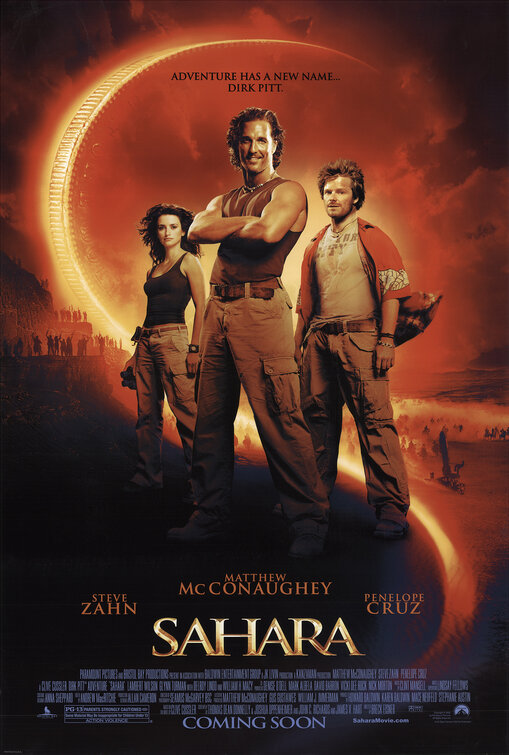
Dirk Pitt is a treasure hunter chasing a rumor: a Confederate ironclad that supposedly sailed across the Atlantic and vanished somewhere in the West African desert. Matthew McConaughey plays him with a grin that says he knows exactly how ridiculous this all is, and the movie is better for embracing it rather than pretending to be anything more serious than a globe-trotting pulp adventure.
Steve Zahn is doing reliable comic-relief best-friend work, Penélope Cruz gets tangled in a plague subplot that gives the plot an excuse to keep moving, and the action swings from gunboats to sandstorms to an actual buried warship without ever slowing down to justify itself. Logic takes a back seat to momentum here, on purpose, and the movie mostly gets away with it.
Sahara knows exactly how silly it is and never once slows down to apologize.
It's a big, dumb adventure in the best sense of both words, closer in spirit to a Saturday matinee serial than a modern blockbuster, and it never once apologizes for that. Some of the effects show their age and the plot doesn't hold up to close inspection, but if you sign up for pulpy escapism, Sahara delivers exactly that, at a brisk and enjoyable pace.
Sahara was adapted from Clive Cussler's bestselling Dirk Pitt adventure novels and built as a swashbuckling starring vehicle for Matthew McConaughey, but the production became notorious behind the scenes. Its screenplay passed through roughly ten writers before shooting began, and costs climbed well past initial estimates as filming stretched across multiple countries. The expensive production and modest box office return triggered a long-running legal dispute between Cussler and producer Philip Anschutz over creative control and financial responsibility, a fight that dragged through the courts for years afterward. Despite the turmoil, the film built a loyal following among fans of old-fashioned, globe-trotting adventure stories in the Indiana Jones mold.
McConaughey hoped Sahara would launch Dirk Pitt into a recurring franchise in the spirit of James Bond, and he threw himself into promoting it, even driving a poster-wrapped Airstream trailer across the country to build buzz at military bases and NASCAR events. Its box office performance ended those ambitions, but the film endures today as a pleasant curiosity, an unabashedly old-fashioned adventure romp with a charismatic lead, a game supporting cast, and an emphasis on globe-trotting fun over grit. Viewers nostalgic for pre-CGI-heavy action adventures often rediscover it fondly on cable or streaming.
Sahara also carried an unusually prestige-adjacent soundtrack for a popcorn adventure: composer Clint Mansell, better known for darker, more experimental work, scored the film and won a BMI Film & TV Award for it, while McConaughey himself sang an original end-credits song, "I Just Wanna Be Your Everything." Much of the production shot on location in Morocco alongside additional work in the United Kingdom, chasing the same sun-baked, sweeping desert vistas that made the Dirk Pitt novels so popular in print. None of that scale translated to profit — Sahara's worldwide gross of roughly $119 million, against a budget that reportedly doubled to around $160 million during production, left it remembered as one of the more spectacular box office bombs of the 2000s.