
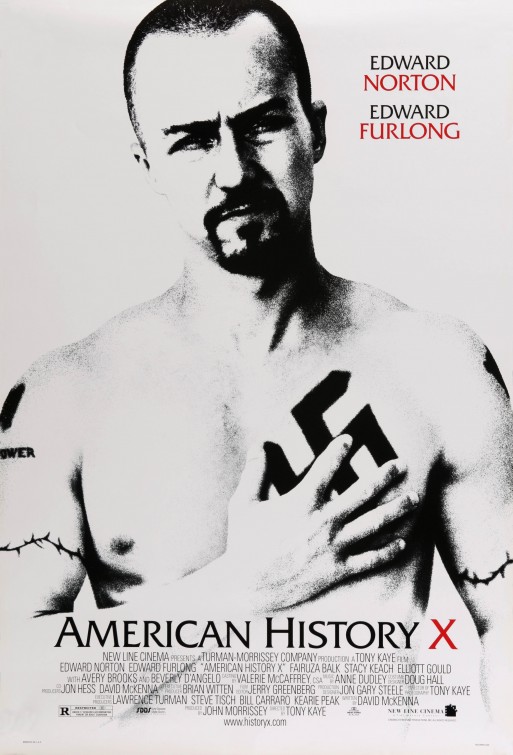

American History X works because it refuses to let its skinhead protagonist off easy, even as it argues he can change. Tony Kaye shoots Derek Vinyard's past in stark, near-overexposed black-and-white and his post-prison present in muted color, a device that could feel gimmicky but instead makes every flashback land like a wound reopening. Edward Norton plays both versions of the character without softening either one into a simple redemption arc.
What keeps the film from tipping into after-school-special territory is how much weight it gives the people around Derek rather than Derek himself. Edward Furlong's Danny, narrating through a school essay assignment, is the real audience surrogate, and his slow unraveling feels more tragic because we've already watched his older brother's transformation fail to fully take. Beverly D'Angelo and Avery Brooks ground the film's ideas in domestic exhaustion rather than lecture.
A curb-stomp that still winds you, and a performance that outgrew all the noise behind the scenes.
The making of the film became almost as notorious as the film itself. After test audiences responded poorly to Kaye's original cut, New Line brought Edward Norton into the editing room, and the version that reached theaters ran roughly 40 minutes longer than Kaye's preferred edit. Kaye's response was operatic: he petitioned to have his name replaced with 'Humpty Dumpty' in the credits and took out full-page trade-paper ads denouncing Norton and the studio.
Reviews were mixed at the time, but audiences and later critics have been considerably kinder, with the film settling around 84% on Rotten Tomatoes and building a reputation well beyond its modest $23.9 million worldwide gross against a $20 million budget. Norton's performance earned the film's only Oscar nomination, for Best Actor, losing to Roberto Benigni.
Norton's physical transformation for the role is its own quiet feat of craft: he reportedly put on close to 30 pounds of muscle in the months before filming so that Derek would read as genuinely dangerous rather than performatively tough, and the prison-yard ink — the swastika across his chest, the eagle on his biceps, DOC inked down his back for Disciples of Christ — was reapplied fresh for nearly every day on set. That level of physical commitment matches the tonal discipline of the performance: the swagger in the black-and-white flashbacks never once bleeds into the chastened present-day Derek, and that hard line between the two men is exactly what makes his arc toward decency believable instead of convenient. It is the rare case where a well-worn awards-season strategy — physical transformation as shorthand for commitment — actually serves the story rather than just the campaign.