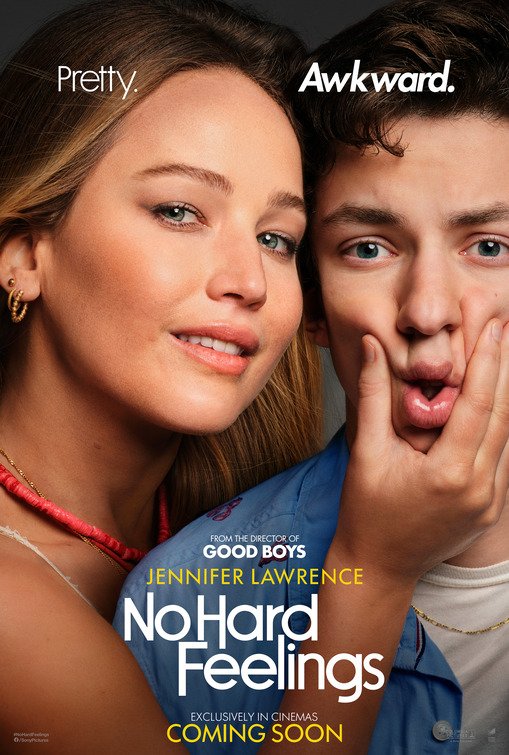
No Hard Feelings gets away with a premise that could easily curdle into something mean-spirited because it commits to the awkwardness on both sides of its central pairing. Gene Stupnitsky, working from the same rowdy-but-warm sensibility he brought to Good Boys, keeps Maddie's desperation and Percy's arrested social development equally sympathetic rather than making either character purely a punchline. The film's raunchiest beats — and there are several fully committed, go-for-broke ones — work because they're grounded in specific, lived-in humiliation rather than shock for its own sake.
Jennifer Lawrence hasn't done broad studio comedy at this scale before, and she plays Maddie's financial panic as the real engine under the film's more absurd set pieces, which keeps the movie from floating away into pure farce. Andrew Barth Feldman, in his film debut opposite an Oscar winner, holds his own by leaning into Percy's over-articulate nervousness instead of playing him as a simple naif — their scenes together have an improvisational looseness that suggests real trust built during production, particularly in the quieter conversations where the film briefly drops the comic premise entirely.
Hire a stranger to date your awkward son — what could possibly go wrong.
Lawrence has said the film's most talked-about sequence, a nude beach-fight scene, took a full day of rehearsal and shooting and that she 'didn't even have a second thought' about doing it, treating the whole thing as physical comedy rather than anything precious. Much of the shoot took place on Long Island near Feldman's childhood home, and he's said he stayed in his own old bedroom during production, delaying his enrollment at Harvard to take the role — a detail that mirrors the film's own theme of a kid who isn't quite ready to leave home yet.
Reviews were solid without being rapturous, with Rotten Tomatoes' top-critic consensus landing around the high 60s, and the film grossed roughly $87 million worldwide against a reported $45 million budget — a respectable result for an original R-rated comedy released into a summer box office dominated by franchise sequels and superhero tentpoles. It's since been cited as evidence that mid-budget, star-driven studio comedies can still find a theatrical audience when the marketing leans into a clear, high-concept hook, with Lawrence's willingness to fully commit to the film's broadest physical comedy widely credited by critics as its biggest asset.
The premise wasn't invented in a writers' room — it started with a real Craigslist ad that producer Naomi Odenkirk stumbled across in the site's "Casual Encounters" section, in which parents offered a car to any young woman willing to date their shy 19-year-old son. Odenkirk passed it along to fellow producer Marc Provissiero, who brought it to Stupnitsky, and Stupnitsky in turn showed the ad to Lawrence over dinner, where she found the idea funny enough to sign on. Nobody ever actually responded to the real posting, so everything that follows — Maddie, Percy, the beach fight, the string of awkward dinners — is entirely invented, but the film keeps the loose, slightly seedy plausibility of an actual Craigslist listing at its core, which is part of why the concept sells even once the plot gets broad.