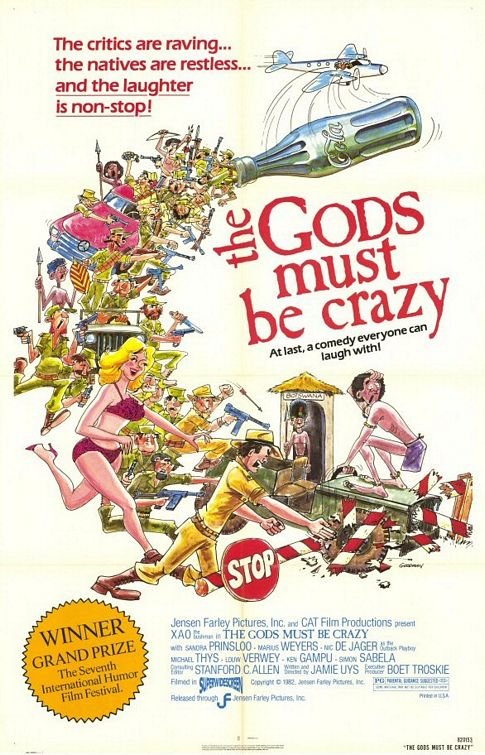
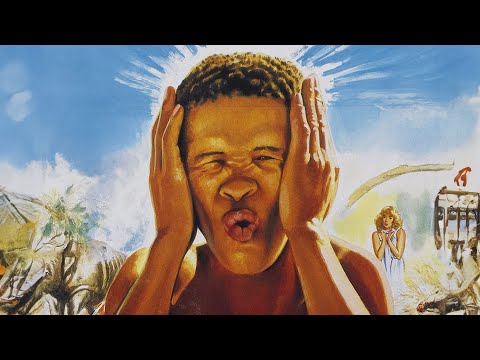
A pilot tosses an empty Coke bottle out of his plane, it lands unbroken in the Kalahari, and the arrival of this one utterly ordinary object cracks open the harmony of Xi's community, who have no framework for owning things and start fighting over an object of pure convenience. Xi, played by N!xau, sets off to walk to the edge of the world and throw the thing off it, for everyone's sake.
Around that journey, Jamie Uys stitches together a klutzy biologist, a runaway teacher, and a squad of comically incompetent guerrillas, all colliding through pratfalls, sped-up chases, and genuinely well-built physical comedy that still holds up as pure slapstick craft. It's gentle rather than biting as satire, more interested in laughing at modern life's clutter than making a hard political point, and some of its framing of Indigenous life reads dated by today's standards.
Proof that the simplest object in the world can still start the biggest mess
None of that stops it from being enormously, durably funny, a global word-of-mouth hit for good reason, with a physical-comedy rhythm few films from any era have matched, chase scenes and all. 4.4 ears and 80% worth your time is a well-earned score for a movie that's aged in some of its politics but not one bit in its laughs.
The Gods Must Be Crazy was written, directed, produced, and edited by South African filmmaker Jamie Uys, and financed entirely through local South African sources rather than international studio backing. It went on to become the most commercially successful film in South African box-office history and an unexpected worldwide crossover hit, particularly in the United States years after its initial release. Its lead, Nǃxau ǂToma, was a San farmer from Namibia with no prior acting experience, discovered by Uys and cast as Xi, the tribesman whose journey with a discarded Coca-Cola bottle drives the story. The film blends slapstick physical comedy with a nature-documentary visual style.
The film's success came with a well-documented and uncomfortable pay disparity: despite its worldwide gross reportedly exceeding $100 million, Nǃxau was paid only a small fraction of that for his starring role, though Uys later supplemented his earnings with additional payments and a stipend. That history has complicated its legacy even as its gentle, largely dialogue-light comedy has kept it in circulation as a crossover classic for decades. It tends to appeal to viewers who enjoy old-fashioned slapstick and fish-out-of-water culture-clash comedy, though modern viewers often approach its politics of representation with a more critical eye than audiences did in 1980.
Nǃxau's story didn't end with that first payday dispute. He returned for The Gods Must Be Crazy II in 1989, this time reportedly negotiating a fee of more than half a million dollars, a dramatic jump from the token amount he'd received for the original, and went on to appear in several more follow-ups, including Crazy Safari and Crazy Hong Kong, spin-offs that traded on the character's popularity in Asian markets. He died in 2003 in Namibia's Kalahari region, reportedly of tuberculosis, at an age even he wasn't entirely certain of, since exact birthdates were rarely recorded for members of his community. It's a strange coda for a film that started as a lighthearted comedy and ended up defining how one man was seen by audiences worldwide for the rest of his life.