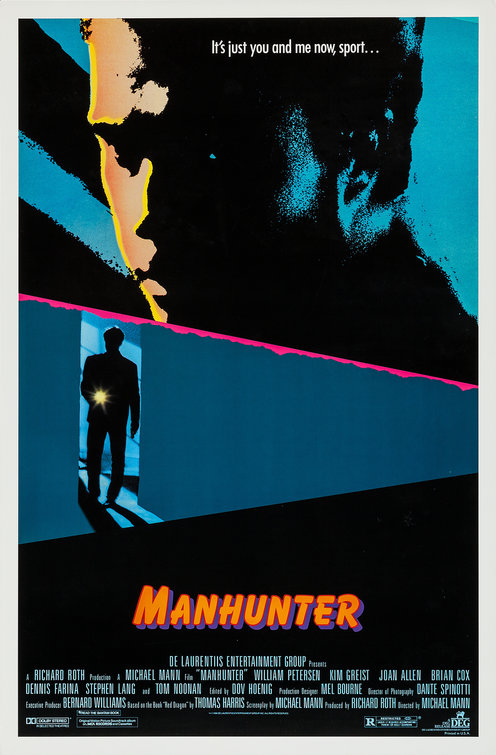

Manhunter is the rare 'first adaptation' that still holds up as arguably the best one: Michael Mann's cold, glassy visual style turns a serial-killer procedural into something closer to a mood piece, all blue light and empty modernist interiors, and it's a far more unsettling approach than the film's reputation as a dated 80s thriller might suggest. William Petersen plays Will Graham as a man barely holding himself together, and the film is smart enough to make his fragility the real subject rather than the killer's theatrics. This is confident, controlled filmmaking from a director who was already years ahead of the genre.
Brian Cox's Hannibal Lecktor gets a fraction of the screen time Anthony Hopkins would later get, and that's exactly why the performance works so well — he's dangerous specifically because he's contained, precise, and only ever a supporting figure in someone else's story. Tom Noonan, meanwhile, brings a genuinely disturbing vulnerability to the killer role that most slasher-adjacent thrillers of the era never bothered to attempt. Together with Mann's clinical direction and a score that leans into synth-driven dread rather than orchestral stings, the film builds a specific, uncomfortable atmosphere that few genre films from its decade ever matched.
The coldest, strangest, most visually striking Hannibal Lecter film — and it came first.
It was a box office disappointment on release, and it's easy to see why: this is a cold, deliberately paced film that asks for patience rather than delivering easy shocks, and it looks nothing like the more famous Hannibal Lecter films that followed it. But that's exactly the case for watching it now — if you already know The Silence of the Lambs or the 2002 Red Dragon remake, Manhunter is the moodier, stranger, more visually distinctive version of this story, and it rewards viewers who want their serial-killer thrillers to feel unsettling rather than sensational.
Manhunter adapts Thomas Harris's novel Red Dragon, and was in fact originally set to carry that title until producer Dino De Laurentiis changed it after another of his films underperformed at the box office. Michael Mann spent years developing the script and researching alongside the FBI's Behavioral Science Unit before casting William Petersen as Will Graham, having passed over more established names considered for the role, including Paul Newman and Mel Gibson. The film underperformed on its initial release, grossing only around $8.6 million domestically, but has since been reassessed as a foundational work in the serial-killer thriller genre, now holding an 89% approval rating on Rotten Tomatoes alongside its 1987 Edgar Award nomination for Best Motion Picture.
Manhunter sits at the start of a visual and tonal language Michael Mann would keep refining across Heat, Collateral, and Miami Vice — cool color palettes, alienated professionals, violence shot with a kind of detached precision — and fans of that later work will recognize the DNA immediately. It has also earned a devoted following among horror and thriller fans specifically because it refuses to sensationalize its killer, treating the investigation as psychologically corrosive rather than thrilling in a conventional sense. Recommend it to anyone who prefers mood and craft over jump-scares, or who wants to see where the modern serial-killer thriller genre actually started.