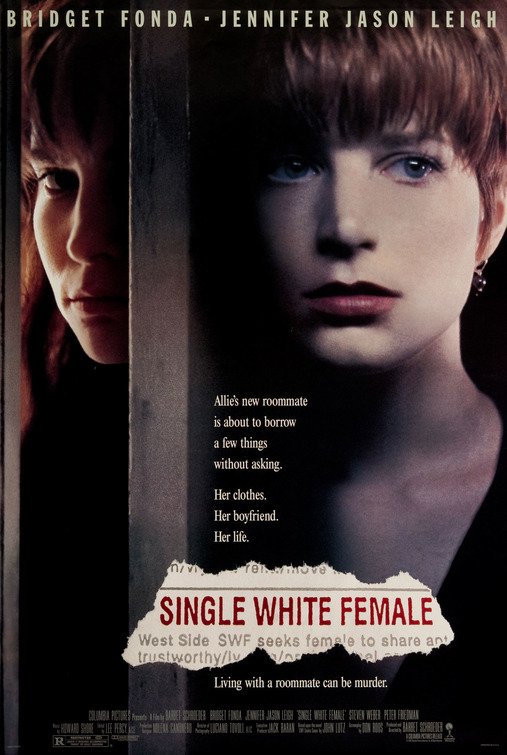

Single White Female is a genuinely effective psychological thriller built on a premise that's simple, relatable, and quietly terrifying: what if the person you let into your home wants to become you? Barbet Schroeder directs with real control, letting the dread build gradually through small, unsettling details, a haircut, a stolen boyfriend, a copied outfit, before escalating into full-blown horror. Bridget Fonda is a convincing, sympathetic lead, but the film belongs to Jennifer Jason Leigh, whose performance as the increasingly unstable roommate is calibrated perfectly between pitiable and genuinely frightening.
What keeps the film from feeling dated is how grounded the setup remains even as the plot escalates; the horror comes from something ordinary, sharing an apartment with a stranger, curdling into something invasive and inescapable. Jennifer Jason Leigh commits fully to the role's discomfort, never playing the character as simply evil, which makes her scarier than a more theatrical performance would have been. The New York apartment setting itself becomes a character, its shared walls and hallways turning claustrophobic once trust breaks down completely.
The roommate thriller that made everyone check their locks a little more carefully.
This is a strong recommendation for anyone who enjoys psychological thrillers built on performance and slow-building dread rather than jump scares or twists for their own sake. It holds up as one of the defining roommate-horror stories of its era, and Jennifer Jason Leigh's work here is reason enough to watch it on its own. Recommend it to fans of character-driven suspense who want a film that takes its central relationship, and its unraveling, completely seriously. It's the kind of thriller that stays effective precisely because its premise could happen to anyone.
Single White Female is based on John Lutz's 1990 novel SWF Seeks Same, adapted for the screen by Don Roos, and released by Columbia Pictures in 1992. The production reportedly reshot its ending after a test screening didn't land the way filmmakers intended, a common but telling sign of how carefully the studio calibrated the film's tone before release. Jennifer Jason Leigh's performance became the film's most celebrated element, earning her a Chicago Film Critics Association nomination for Best Actress alongside an MTV Movie Award for Best Villain, an unusual pairing that speaks to how effectively she balanced sympathy and menace in the same role.
The film helped cement a specific early-90s thriller subgenre built around domestic intrusion and identity theft between women, and its influence is still visible in roommate and doppelganger thrillers made decades later. It's a good match for viewers who enjoy Fatal Attraction-style erotic thrillers but want something more claustrophobic and interior, driven by two women's performances rather than a love triangle. Barbet Schroeder, better known for more art-house work like Barfly and Reversal of Fortune, brought an unexpectedly disciplined genre sensibility to the material. For horror and thriller fans building out a 90s watchlist, this remains one of the era's sturdiest entries.